
One Day in Genoa: The Best Itinerary for First-Time Visitors

While many people miss Genoa in favour of nearby Milan, there is so much to see and do in the city of Genoa that you absolutely cannot miss it from your Italy itinerary!
This guide is for first-time visitors who have at least one day in Genoa, whether you are visiting as part of a shore excursion, as a day trip from Milan, or whether you’re just doing a short weekend trip instead.
Genoa (or in Italian ‘Genova’, and in Ligurian ‘Zêna’) is a maritime city on the northwestern coast of Italy, and is the capital of the region of Liguria. It’s actually the sixth-largest city in Italy, with over 800,000 residents!
Historically, Genoa has always been an important city in Europe, predominantly due to its port. It currently has the busiest port in Italy and is the twelfth-busiest port in the EU.
Genoa was the capital of one of the most powerful maritime republics (the Republic of Genoa) in the world for over seven centuries, stretching from the 11th century to 1797. During the 16th and 17th centuries, Genoa was one of the financial centres of Europe, and all of this comes together to make Genoa an incredible place to spend a few days and learn more about its impressive history.

If you only have one day in Genoa, then you have to be a little picky with your itinerary – you could easily fill a week with all the different places to see and things to do in this city, especially if you start including day trips. We spent a total of three days in Genoa, so I have taken everything we did in the city and refined and condensed everything to be the ideal one day itinerary for this beautiful city.
This one-day Genoa itinerary will cover the must-see attractions, the best places for authentic Genoese cuisine, and include various travel tips such as how to get to Genoa, where to stay in Genoa, and more.
Genoa is an ideal stop on a longer Italy trip, whether that’s northern Italy, the Italian Riviera, or even a grand Italy tour. Genoa is well connected to nearby Milan, as well as to Rapallo and La Spezia on the Italian Riviera, and further away cities such as Pisa and Rome. If you’re planning to continue down the Italian Riviera, then don’t miss my guide on how to spend a day in Cinque Terre.

Is it worth visiting Genoa for a day?
Absolutely! Even if you only have one day in Genoa, it’s absolutely enough to see some of the main attractions in the city.
Many cruise ships include Genoa on their itinerary, and I highly recommend making the most of your time in this city. Skip the day trip all the way to Milan and simply get a transfer from the cruise port to the city centre and explore this beautiful, historic city. It’s much less busy than Milan and is well worth visiting.
Is one day in Genoa enough?
One day in Genoa is absolutely enough time to see some of the main attractions, including at least one palace, do a tour, and explore the historic centre. If you want to see more attractions, then you’ll feel quite rushed trying to do it in just one day, so you’re much better off spending two or three days in this port city instead.
How many days should you spend in Genoa?
If you only have the option for one day in Genoa, then spend just the one day! However, if you do have the option to spend longer in the city, I would recommend spending two or three days to truly see more than just the surface.
It will also allow you to explore the city at a much more relaxed pace, which is how I prefer to experience a city. Spending three or more days in Genoa will allow you to enjoy the city at a more Italian pace – take time to enjoy your cappuccio and your focaccia without feeling like you need to be visiting the next sight or attraction. Savour a two-hour dinner in Boccadasse after you enjoy the sunset with an aperitivo.

How do I spend a day in Genoa? A summary:
Read on for the full itinerary, but if you want the Cliff Notes of the full trip, this is what we’re going to get up to on our day in Genoa.
We’ll start the morning with coffee and focaccia before heading to meet our tour guide for a tuk-tuk tour of Genoa. Our tour will take us around the Porto Antico and then to the historic heart of the city, including Piazza Banchi, Piazza dei Macelli, Porta Soprana, and San Lorenzo Cathedral.
After this, we’ll say goodbye to our guide and go grab a coffee and lunch (if you started your tour around 11am), before heading to the cathedral to fully explore the interior and walk up to the roof.
After exploring the San Lorenzo Cathedral, it’ll be time to head to Via Garibaldi and explore the impressive palaces of Genoa before heading over to the most spectacular of them all – Palazzo Reale.
Once you’re completely palace-d out, it’s time to get a tasty dinner before heading back to your hotel or whenever you came to visit from!
Keep on reading for all the details, and find a handy map at the bottom of this article that you can import right into Google Maps to make navigating the city simple!

One Day in Genoa: The Best Itinerary for First-Time Visitors
One day in Genoa itinerary: Morning
Start your day with a quick breakfast at one of the many Mentelocale Bar Bistrots around the city. We loved these little cafés and they’re perfect for grabbing a tasty cappuccino (often just called a cappuccio around these parts) and some focaccia. They do different types of focaccia, so whether you fancy a focaccia al pomodoro (tomato), focaccia alla cipolla (onion), or just a focaccia semplice (plain), you’ll be sure to enjoy a filling and delicious breakfast.
- Where: Various locations around Genoa including Calata Simone Vignoso, 4, near where the city tour begins
- When: Monday 07:30-18:00, Tuesday to Friday 07:30-20:00, Saturday 08:00-19:00, Sunday 08:00-18:00
- How much: Around €3 for a cappuccino and focaccia

After you’ve finished your breakfast, it’s time for one of the most unique ways to do a city tour – it’s time for a tuk-tuk (rickshaw) tour of the city! We found this tour accidentally when looking for a walking tour of Genoa – which is always my favourite way to explore a new city – and this seemed like an awesome alternative to see more of the city in the time we had! If you opt to simply do a self-guided walking tour instead, you can follow the suggestions that we did on the rickshaw tour (but I highly recommend the guided tour, especially with only one day in Genoa – you get around a lot faster with someone else pedalling the rickshaw!).

Explore Genoa by Tuk-tuk
The tour is offered by a local company, TreeCycle, a young company based in Genoa that offers guided tours on their electric rickshaws. Their guides are incredibly knowledgeable about the area and our guide, Lupe, was an amazing tour guide! Originally from Argentina, she moved to Genoa three years ago and has been guiding for the past few years. She took us on our two-hour tour of the city, starting in Porto Antico (the old port), where she explained the maritime history of Genoa, and then past Palazzo San Giorgio and into the historic town centre.
During the Late Middle Ages, Genoa was a major commercial power in both the Mediterranean and the Black Sea. Genoa had a variety of names, including “la Superba” (“the Superb one”), “la Dominante” (“The Dominant one”), “la Dominante dei mari” (“the Dominant of the Seas”), and “la Repubblica dei magnifici” (“the Republic of the Magnificents”).
We were quite lucky in our day for a tour as there were no cruise ships in port that day – while Genoa is much less touristy compared to Milan, the city gets a fair bit busier when there’s a cruise ship docked! If you are planning to visit Genoa on a day trip from another Italian city, check the port schedule to see if there will be a cruise ship in! If you have flexibility on when you can visit, this is a great way of ensuring places are less busy during your trip.

From Porto Antico we could also see the lighthouse of Genoa, known as the ‘Lanterna’ and an icon of Genoa. At 77 metres, it is the tallest lighthouse in the Mediterranean and the second tallest in the world, second only to Île Vierge Lighthouse in Finistère, France. It’s also the fourth-oldest lighthouse in the world! The lighthouse was originally built in 1128 and then reconstructed in 1543, and its 172 steps can be climbed up to the viewing terrace for beautiful views of the harbour and beyond. We didn’t have the opportunity to climb up the lighthouse (we were there on a Thursday, when it’s closed) but if you get time and visit when it’s open to visitors, then this is a great spot for views of Genoa!
- Where: Rampa della Lanterna
- When: Closed Monday to Thursday, Friday to Sunday 10:00-18:00
- How much: €8 to entry and climb the steps to the viewing terrace

From Porto Antico, our tour took us to Palazzo San Giorgio, one of the hundreds of palaces in the city of Genoa. The palace is truly impressive, made even more unique by the fact that its entire exterior is painted. The palace has an extensive history, and was the location of the prison where Marco Polo was held captive, having fallen prisoner of the Genoese during the Battle of Curzola in 1298. In 1407, the building became home to the Bank of Saint George (or by its full name in Italian: Casa delle compere e dei banchi di San Giorgio), one of the first banking institutions. The bank administered the public debt and managed the revenues of the taxes, a role it would play until 1797 when the Republic of Genoa fell.
The building was majorly refurbished during the 15th and 16th centuries, and then the Genoese painter Lazzaro Tavarone was given the assignment of painting the façade. Between 1606 and 1608, Tavarone frescoed the seafront with figures of notable Genoese and, in the centre, Saint George Killing the Dragon. It’s a truly impressive piece of architecture – make sure to get up close and you’ll see that even the brick texture is all painted on! The building is now (and has been since 1903) home to the Genoa Port Authority. I wish my office looked that epic!

Explore the Historic Centre of Genoa
From here, continue on your tour to Piazza Banchi. Located close to the port, this square was once the site of Genoa’s old grain market. Its name (originally ‘Piazza dei Banchi’ or ‘square of the banks’) originates from the 12th century, when moneylenders would have their stalls under the porticos of the buildings around the square. In 1855, the piazza also became the site of the first Commodities and Stock Exchange in Italy.
In the heart of the square, the Church of San Pietro in Banchi is a unique example of a religious building blended with commercial establishments and living quarters. Steps lead up to the entrance of the church, which stands above shops and other commercial buildings on the ground floor, while apartments exist above the church as well!
- Where: Piazza Banchi
- When: Monday to Sunday 08:30-14:30
- How much: Free entry


The next stop on our tour was another unique church – this time unique thanks to its TWELVE confessionals. Welcome to the Chiesa di Santa Maria Maddalena e San Girolamo Emiliani. I’ll give you three guesses as to why this church had so many confessionals…
Was it because Genoa was the city of banking? Actually, no!
Was it because everyone thought the Genoese were naughty, naughty people? Well, not that I’m aware of.
Was it because the Maddalena district, where the church is located, was (and still is) the red-light district of Genoa? Ding, ding, ding!
Due to its location in the heart of the Maddalena district and the many, many sailors and businessmen who traversed Genoa on their travels, the Chiesa di Santa Maria Maddalena was built with enough confessionals to accept confession from the many men who ahem ‘utilised’ the services available in the area and then needed somewhere to cleanse their souls.
- Where: Piazza della Maddalena, 11
- When: Monday to Friday 08:00-18:00, Saturday and Sunday 10:30-18:00
- How much: Free entry

One of the incredibly interesting things about Genoa, which Lupe – our guide – explained to us, is that there is still an operational red-light area in the city. Historically, all prostitutes working in Genoa were regular taxpayers. As workers, they also did not work Saturdays and, on Sundays, they went to church (although they were required to dress in yellow). They were all required to be registered and, in theory, have health checks done. Prostitution is still legal in the city, and you will see sex workers standing outside during the day and night, but brothels and pimps are illegal. We didn’t feel at all unsafe in the red-light district, either during the day or at night, but simply take care and don’t take photos of the sex workers.
Our tuk-tuk tour also took us to Piazza dei Macelli – the historic ‘square of butchers’, with various places to eat that smelled amazing – as well as Porta Soprana and Casa di Cristoforo Colombo.

See the Old City Gate
Porta Soprana is the best-known gate of the Walls of Genoa, the old walls that once encircled the entire city. The Porta Soprana was once the entryway to the city of Genoa to anyone who approached the city from the east. New city walls were constructed in the 12th century to defend the independence of the Republic of Genoa from the expansion plans of Emperor Federico il Barbarossa, the Holy Roman Emperor, who also held other titles including the King of Germany and King of Italy. Barbarossa enacted various campaigns to take over more and more of Italy, and captured Milan in 1158. The vast majority of the inhabitants of Genoa assisted with constructing the city walls – both financially and physically – which enabled the walls to be completed very quickly between 1155 and 1159. The city walls were aptly named the ‘Walls of Barbarossa’ (Mura di Barbarossa), and two of the three city gates still remain standing.
In the 19th century, the towers of Porta Soprana were used as a prison. A long inscription on the wall of the entrance arch addresses the citizens who pass through the gate, reading: “I am guarded by soldiers, surrounded by beautiful walls and with my value, I cast away the darts of the enemies. If you bring peace, you may approach this gate; if you seek war, you shall return sad and beaten”.
- Where: di Soprana, Via San Pietro della Porta
- When: Accessible 24/7
- How much: Free!

Not far from Porta Soprana, you can find the ‘Casa di Cristoforo Colombo’, or the house of Christopher Columbus. This was the childhood residence of the navigator Christopher Columbus (Cristoforo Colombo in Italian, Cristóbal Colón in Spanish), which was rebuilt in the 18th century after the bombardment of 1684 by King Louis XIV. You can go inside the house, although we opted not to. It’s a very pretty building to observe from the outside, though, so even if you’re just passing nearby, make sure to check it out.
- Where: Via di Porta Soprana
- When: Closed Monday, Tuesday to Friday 10:00-18:00, Saturday and Sunday 10:00-19:00
- How much: €15 entry, free to enjoy the façade from the outside!

The final stop of the morning is the impressive Piazza San Lorenzo and San Lorenzo Cathedral. If you visit the cathedral as part of the rickshaw tour then don’t fear – we’ll be returning later to fully explore the cathedral!
Our tour ended and we were dropped off at our starting point, close to Palazzo San Giorgio. Since our tour started at 11am, it was definitely time for lunch. If you book your tour for earlier in the day, you may want to continue exploring the historic centre a little more until you’re keen for lunch.
Time for lunch!
One of the best options for lunch in Genoa is Zimino, a traditional Ligurian restaurant located just a few minutes walk from Palazzo San Giorgio. This restaurant came highly recommended by our tour guide Lupe, but unfortunately for us, it was completely full when we arrived. This is a proper locals’ spot, with many local dishes (including lasagne al pesto, minestrone alle genovese, and lots more) all costing €10 or less per dish.
- Where: Vico delle Scuole Pie, 4
- When: Closed Saturday and Sunday, Monday to Friday 12:15-15:15
- How much: Approximately €10-15 per person, depending what you order
If Zimino is also too full when you visit, I highly recommend our backup lunch spot, just across the street from Zimino. Pastificio Artigianale di Canneto is another excellent little local spot, this one dedicated to delicious handmade pasta! You can choose whichever pasta you like and whichever sauce you fancy, although they do have pairing suggestions in case you’re not sure what will go best together. You can even buy uncooked pasta to then take home and cook! When in Genoa, you have to try something al pesto and you also shouldn’t miss trofie, a type of pasta typical to this region. We tried the imperiali with cacio e pepe (so ridiculously good) and the ravioli al tartufo – they were both excellent, but my personal favourite was the cacio e pepe!
- Where: Via di Canneto Il Curto, 49
- When: Monday, Tuesday, Thursday, Friday and Saturday 09:30-19:30, Wednesday and Sunday 09:30-15:00
- How much: We paid €18 for two small portions of pasta, plus two soft drinks, so I’d estimate around €9-13 per person depending how hungry you are


If you feel like a quick coffee before heading off on your afternoon exploration, then Tazze Pazze is a nearby coffee shop that does an excellent cold brew!
- Where: Piazza Cinque Lampadi, 71R
- When: Monday 08:00-20:30, Tuesday to Saturday 08:00-17:30, Sunday 09:00-20:30
- How much: We spent €6.70 on two cold brew coffees, so €3.35 per person
One day in Genoa itinerary: Afternoon
Visit Genoa’s Cathedral
After filling your belly with pasta and your veins with caffeine, it’s time to continue our exploration of the beautiful city of Genoa. First on our Genoa itinerary this afternoon is a visit to the iconic Genoa Cathedral, or Cattedrale di San Lorenzo, which you will have seen briefly on the rickshaw city tour earlier in the day.
This Roman Catholic cathedral is dedicated to Saint Lawrence (San Lorenzo in Italian) and is the seat of the Archbishop of Genoa. The cathedral was consecrated in 1118 by Pope Gelasius II and was built fundamentally in a medieval style, although the main façade is in a Gothic style from the 13th century.

If you travel further around the Ligurian region, you’ll see other churches and cathedrals with a similar style to Genoa Cathedral. The distinctive white and grey striped style (here the materials are marble and slate) is a common architectural style across many Romanesque churches and cathedrals in Italy, and you’ll find a similar style at the Cathedral of Siena and the Basilica di San Francesco in Arezzo. According to some theories, the two colours used were symbolic of ‘good and evil’ or ‘light and dark’, while other sources simply believe it was for aesthetic reasons, as well as what materials were common to use. Other reasons for the architectural style include that this style of architecture used different shades of stone to exaggerate the buildings’ breadth, making the building look even more imposing than it is. There was also a practical reason for the stripes since alternating layers of brick and stone helped reinforce the structure.

All in all, there are a variety of reasons (and theories) as to why this white and grey striped appearance is common across many churches and cathedrals in Italy, but whatever the reason is – it’s truly impressive!
The cathedral actually took over six centuries to fully construct, with construction finally being completed in the 17th century! According to legend, the reason that the cathedral only has one tower (and therefore is not symmetrical) is due to money running out… but who knows, maybe it was just a design choice!
The cathedral is completely free to enter, but it costs €5 per person to climb the (approximately 140) steps to the loggia at the top of the northeastern tower). This is well worth doing as the views of the city and the cathedral are excellent from up here!
- Where: Piazza San Lorenzo
- When: Closed Saturday and Sunday. Monday to Friday 08:00-12:00 and 15:00-19:00.
- How much: Entry to the cathedral is free; €5 to climb the steps to the tower


After climbing all the way to the top, enjoying the views and climbing all the way back down, it’s an ideal time to treat yourself to some gelato. After all, you are in Italy!
Just across from the cathedral, you’ll find a small gelateria called Fruit & Ice Cream Factory, where you can enjoy a variety of different flavours. I recommend trying the ‘al basilico’ flavour… it’s essentially pesto ice cream! It’s somewhat of an acquired taste, but it did taste very refreshing after climbing all those stairs. They also have an excellent selection of senza latte flavours, ideal if you’re lactose intolerant or vegan, or just want to go for a slightly healthier option. You can also ask to try a few samples if you can’t choose which flavour(s) you want! We returned to the front of the cathedral to sit on the steps and enjoy our gelato, which was a perfect break and opportunity to rest our legs after all that stair climbing.
- Where: Via San Lorenzo, 55R
- When: Monday and Tuesday 11:30-22:00, Wednesday and Sunday 11:30-22:30, Thursday to Saturday 11:30-00:30
- How much: We spent €6 on two small gelati, so €3 per person (or more if you want a biiiiig gelato)

Head to Genoa’s Main Square
One of my favourite things to do in a city is to simply go on a walk and see what pretty corners you find on the way – since you only have a day in Genoa, we won’t go on an aimless stroll, but rather head in the direction of the Piazza De Ferrari, the city’s main square.
The square is mainly known for its impressive bronze fountain, as well as the historic buildings that surround the square. It’s home to institutions like the stock exchange (in a very impressive building, which was built in 1912) and the Carlo Felice Theatre. Historically the square was the location of many of the important financial institutions of Genoa!
The square’s name, De Ferrari, is due to its dedication to Genoese banker and politician Raffaele De Ferrari, Duke of Galleria.
Obscure fact: Raffaele De Ferrari had three children – two daughters and a son. His son was, apparently, an eccentric stamp collector and refused to inherit his fortune and the title of Duke when his father died.


The rest of the afternoon will be dedicated to palace exploration, which is an absolute must-do when in Genoa. Even with only one day in Genoa, you can’t miss visiting a palace or two while you’re here!
Important Note: As with many places in Italy, a lot of the historic sites in Genoa are closed on Mondays! The palaces I mention below in the itinerary are all closed on a Monday, so if you can visit on a day that ISN’T a Monday, that’s highly recommended!
Stroll Via Garibaldi and Visit the Palaces of Strada Nuova
Firstly, head to Via Garibaldi to meander down this beautiful, historic street. It was originally known as ‘Strada Nuova’ (New Street) when it was first built in the 1550s but was named for the Italian general Giuseppe Garibaldi in 1882. Via Garibaldi is now part of a UNESCO World Heritage Site in Genoa that encompasses the Strade Nuove (’New Streets’, which also encompasses Via Balbi, formerly Strada Balbi, and Via Cairoli, formerly Strada Nuovissima, which amusingly enough means ‘newest street’).
If you plan (and have time) to visit multiple palaces, it’s well worth first visiting the Palazzo Rosso ticket office to purchase a Genova Museum Card.

The Genova Museum Card is a single ticket, valid for 24 hours, which allows you to access any of the 28 city museums, 19 civic museums and 9 non-civic museums, for the price of €15, and also includes public transport. The Museum Card includes all the palaces on this itinerary (Palazzo Rosso, Palazzo Reale, Palazzo Tursi) as well as lots more museums and palaces – you can find the full list here on the Musei di Genova’s website. The Museum Card is excellent value if you plan on just visiting the Palazzo Reale (€10 entry) and Palazzo Rosso (€9 entry, which also covers Palazzo Bianco and Palazzo Doria Tursi), you’re already saving yourself €4 with the museum card, PLUS you get 24 hours of public transport thrown in as well.
Start your palace exploration at Palazzo Rosso, or the ‘Red Palace’. Palazzo Rosso is one of Genoa’s Palazzi dei Rolli (Italian for “Palaces of the Lists”) which is a group of palaces (most of which date from the late 16th and early 17th centuries) that were associated with a particular system of ‘public lodging’ in private residences. In this system, notable guests on state visits to the Republic of Genoa were hosted in one of these palaces. The Palazzi dei Rolli are now UNESCO-recognised, along with the Strade Nuove. In total, there were 162 palaces on the list!

Palazzo Rosso, also known as Palazzo Brignole Sale, has a distinctive red façade which gave the palace its name. The palace was built in 1675, and actually wasn’t one of the original Palazzi dei Rolli, but is included in the UNESCO World Heritage Site. Palazzo Rosso was built by the brothers Rodolfo and Gio Francesco Brignole Sale, based on a design by Genoese architect Pietro Antonio Corradi. Since the palace was to be the home of both brothers, the original plan was to build two side-by-side residences, but this was discarded in favour of two ‘noble floors’, one for each brother.
Palazzo Rosso is incredibly rich in artwork and is a must-visit for any art lover. Works by notable artists such as Anthony van Dyck, Domenico Piola, and Lorenzo Di Ferrari decorate the walls and ceilings of the palace.
- Where: Via Garibaldi, 18
- When: Closed Mondays. Tuesday to Friday 09:00-19:00, Saturday and Sunday 10:00-19:30
- How much: €9 including entry to Palazzi Rosso, Bianco and Doria-Tursi | Included in the Genova Museum Card

After exploring the impressive and beautiful Palazzo Rosso, it’s time to walk across the road and visit Palazzo Doria-Tursi, currently the seat of the Municipality of Genoa. Palazzo Doria-Tursi is the largest of the palaces on Via Garibaldi, and was built in 1565. You can actually enter part of the Palazzo Doria-Tursi for free – the courtyard is free to enter!
If you want to see all of the palace, then you need to enter via the adjacent Palazzo Bianco entrance instead. Since we wanted to spend a lot of time exploring the Palazzo Reale, we only visited the courtyard part of this palace, but if you have time, definitely visit Palazzo Bianco and the rest of Palazzo Doria-Tursi!
- Where: Via Garibaldi, 9
- When: Closed Mondays. Tuesday to Friday 09:00-19:00, Saturday and Sunday 10:00-19:30
- How much: €9 including entry to Palazzi Rosso, Bianco and Doria-Tursi | Included in the Genova Museum Card


Explore the Royal Palace of Genoa
From Via Garibaldi, it’s a pleasant ten-minute stroll to reach the most impressive palace of them all: the Palazzo Reale.
If you know a little of Italian history, you may wonder how an Italian city has a ‘Royal Palace’, given that Italy is a republic and therefore doesn’t have a monarchy, and Genoa also didn’t have a monarchy either (also a republic).
Firstly, construction began on the palace in 1618 for the Balbi family, and the palace was known as the Palazzo Stefano Balbi. In 1677, the palace was sold to the Durazzo family, and then in 1823 the palace was sold to the Royal House of Savoy. The House of Savoy led the Italian Reunification (Risorgimento) in 1861, and ruled the Kingdom of Italy until 1946. Umberto II was the Savoyard King who was the last King of Italy, reigning for just a few weeks before being deposed in 1946, when the Italian Republic was proclaimed.

After the transfer of the capital from Florence to Rome in 1870, the palace was frequented less and less by the royal family, and so in 1919 Vittorio Emanuele III (the King of Italy at the time) ceded the palace to the state. The palace was then transformed into a Museum of Decorative Arts.
There was considerable damage to the Palazzo Reale during the bombings of the Second World War, with parts of its roof being destroyed, but it has since been completely refurbished and renovated and is back to its pre-war beauty.


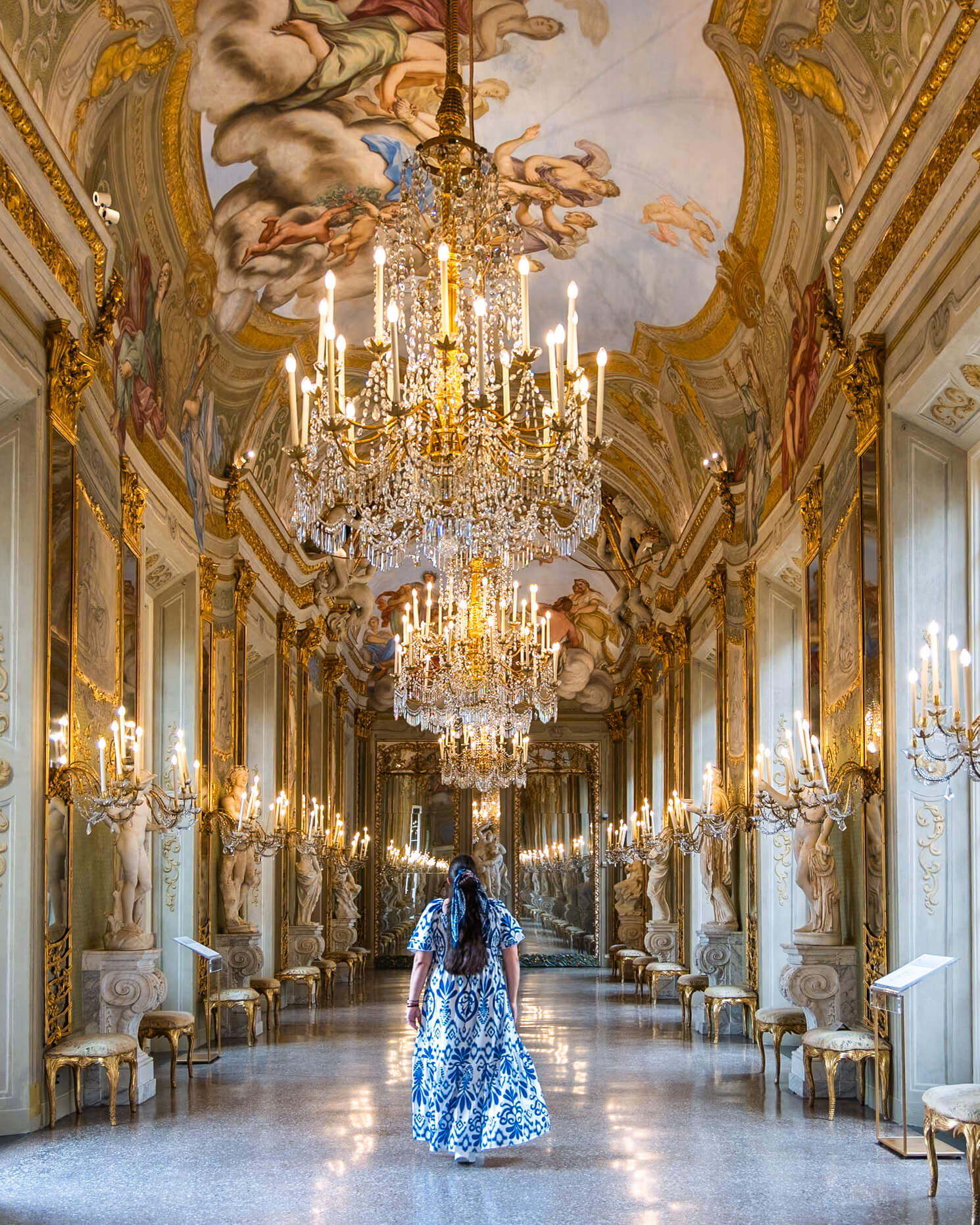
Easily one of the most spectacular parts of the palace is the Hall of Mirrors (Galleria degli Specchi). I felt like I belonged in an Italian spin-off of Bridgerton walking through this room!
- Where: Via Balbi, 10
- When: Closed Mondays. Open Tuesday 13:30-19:00, Wednesday, Thursday & Saturday 09:00-19:00, Friday 09:00-23:00 and Sunday 09:30-19:00
- How much: €10 | Included in the Genova Museum Card

By now, you’ve probably seen enough palaces for one day and you’re getting a little peckish – it’s time for dinner! Genoa has so many excellent restaurants to go for food, so it really depends what you’re feeling like – are you in a pizza mood, or a pasta mood? Maybe some seafood?
For seafood and pasta:
If you’re in the mood for some fresh seafood and maybe a little more pasta, then visit Alla Lunga Ristorante, an award-winning restaurant that works magic with Ligurian cuisine. If you plan to visit, make sure to book a table in advance though!
- Where: Vico Giannini, 14r
- When: Closed Mondays. Open Tuesday to Friday 19:30-22:00 and Saturday and Sunday 12:30-14:30 and 19:30-22:00.
- How much: Set tasting menu from €80 per person, for individual dishes starters range from €16-24, main dishes from €18-30 and desserts all cost €8
For great value pasta and pizza:
If you’re looking for a more budget option than Alla Lunga, I present to you PASTA STREET. If you’re not already pasta-ed out from lunchtime, this place is an excellent spot to enjoy more Genoese pasta dishes!
They also do an excellent selection of pizzas, as well as serving focaccia and some salad dishes. It’s a great value option, if you’re looking for excellent flavour (and craft beer) without spending a tonne!
- Where: Piazza della Meridiana, 12r
- When: Closed Mondays. Open Tuesday to Sunday 12:30-16:00 and 18:00-22:00
- How much: Pasta dishes start at €8.50 while pizzas cost between €8.50-€12.50
Once you’ve enjoyed a delicious Genoese dinner, it’s time to head back to your hotel or to wherever you visited Genoa from!
This one day Genoa itinerary is the perfect way to get an overview of the city and see some of the best sights in the time that you have.

Is Genoa a walkable city?
Yes, Genoa is a very walkable city. It’s a little hilly but not too much, and the majority of the must-see attractions are all within easy walking distance (maximum 15 minutes) of each other.
We never needed to get public transport within the city itself – the only times we used public transport was the bus to get to Boccadasse (which is well worth visiting if you’re staying for longer than just one day) and another bus to get from our hotel to the train station when we left.
Is Genoa worth visiting?
Despite being less talked about than Rome, Florence or Milan, Genoa is absolutely worth visiting! The spectacular palaces throughout the city, the incredible history it boasts and so much more come together to make Genoa a destination that more people really need to know about.

What is the most beautiful part of Genoa?
The most beautiful part of Genoa is generally considered to be the historic centre, especially around Via Garibaldi. Lined with magnificent Renaissance palaces like the impressive Palazzo Rosso and Palazzo Bianco, the architecture here is stunning. These buildings feature elaborate facades, frescoes, and beautifully preserved courtyards.
Another picturesque spot is the colorful fishing village of Boccadasse, with its pastel houses, pebble beach, and stunning views of the Ligurian Sea. It’s an idyllic escape that feels worlds away from the hustle of the city centre.

What food is Genoa known for?
Genoa is best known for its pesto, specifically pesto alla genovese. This fragrant sauce made from fresh basil, pine nuts, garlic, Parmesan cheese, and olive oil is often served over trofie pasta.
Focaccia is another local specialty, and in Genoa, it’s often enjoyed plain, or with toppings like onions, olives, or cheese. In the Ligurian language, it’s known as ‘fugassa’!
You also shouldn’t miss farinata, a savory chickpea pancake that’s crispy on the outside and soft inside. You’ll find these delicious treats in bakeries and trattorias throughout the city.

Is Genoa safe to walk around at night?
Yes, Genoa is generally safe to walk around at night, especially in the more frequented areas such as the historic center, Porto Antico (Old Port), and along the main streets.
However, like in any major city, it’s always wise to stay aware of your surroundings and avoid poorly lit or deserted areas. Genoa’s narrow alleys, known as “caruggi,” can feel a bit intimidating at night, but they are usually safe. Stick to the main routes, and you should be fine.
Even as female travellers on our own, we never felt unsafe walking around Genoa at any time of day or night!
Is Genoa an expensive city?
Genoa is relatively affordable compared to other major Italian cities like Rome, Venice, or Milan. Accommodation, dining, and attractions tend to be cheaper, but prices can vary depending on where you choose to stay and eat.
For example, dining in a local trattoria or pizzeria is usually quite affordable, while more upscale restaurants can be pricier. Entry to most museums and attractions is also reasonably priced, with many offering reduced entry for students and those above retirement age, as well as the Genova Museum Card that includes lots of great museums just for €15!
Overall, Genoa offers good value for money, especially for travellers looking to explore a beautiful Italian city on a budget.
In total, we spent €607.37 for two people, which included two nights of accommodation in the historic centre of the city plus city tax, meals, visits to the palaces and museums, the tuk-tuk tour, a 24-hour bus pass, souvenirs, and our travel to Genoa from Milan, and from Genoa to Rapallo!

So, how much did we spend for one day in Genoa?
Here’s a complete breakdown of how much we spent on one day in Genoa, including two nights of accommodation in the historic city centre! My best friend and I travelled to Genoa in June, so the price is for the two of us, and we shared a twin room at the hotel.
For two nights of accommodation in Genoa, we spent a total of €246.27, or €123.14 each. We also paid €13 for city tax, which is pretty standard in Italian cities.
Our transport included a 24h public transport pass for the city of Genoa, plus our first class train tickets from Milan to Genoa, and our train tickets on from Genoa to Rapallo. The transport cost came to a total of €89.20, or €44.60 each. The majority of that was our first class train tickets from Milan to Genoa, which cost us €58 for the two of us!
Our total spend on attractions and activities was €124.80, or €62.40 each, which included all the museums and palaces we visited, the Genoa Cathedral rooftop, as well as a 2-hour tuk-tuk tour of the city.
Food was our second largest cost behind accommodation, with two breakfasts, one lunch, two dinners, plus multiple gelato and coffee stops (of course), coming to a grand total of €126.10, or €63.05 each.
Our smallest expense was on souvenirs at a grand total of €8 – I always get a magnet of everywhere I go, and we also picked up a few postcards and other bits and pieces.
- Accommodation: €246.27
- Transport: €89.20
- Attractions & activities: €124.80
- Food & drink: €126.10
- Souvenirs: €8.00
Excluding accommodation and onwards travel, one day in Genoa with all activities, attractions and food (breakfast, lunch, dinner, coffees and gelato) came to €251 for two people.
Which part of Genoa should I stay in?
For most visitors, the best place to stay in Genoa is the historic center. This area is full of charm, with its narrow streets, stunning architecture, and vibrant atmosphere, plus you’ll be within easy walking distance of many key attractions, like the Palazzi dei Rolli and the Cathedral of San Lorenzo. Staying here gives you the best access to the city’s cafes, shops, and nightlife, making it a convenient and lively base!
Best places to stay in Genoa on a budget:
For a budget option, the hotel where we stayed on Via Cairoli was great! Hotel Cairoli is a three star hotel, but I will add that it doesn’t have completely step-free access. There is a lift up to the hotel, but there are a few steps to get to the lift itself and some of the rooms are upstairs with no lift access. Depending on the time of year that you visit, two nights at the hotel for a double room starts at around €88 per night.
If you’re looking for an even more budget option, OStellin Genova Hostel is located just off Via Garibaldi and has beds in a mixed dorm from only €21 per night, which is super affordable for the centre of a city! They also have double rooms that start at €75 per night.

Best hotels to stay in Genoa on a mid-range budget:
f you want to stay close to the water, the NH Collection Genova Marina is a great choice. This four-star hotel is located right on the bustling harbour, offering stunning views of the marina. The rooms are modern, spacious, and comfortable, with many featuring private balconies overlooking the sea. The location is perfect for exploring the Porto Antico area and is just a short walk from the Aquarium of Genoa. At €129 a night for a superior double or twin room, it offers excellent value for a central stay with a touch of luxury.
Set in a beautifully restored historical building in the heart of Genoa, Hotel Palazzo Grillo offers a unique blend of old-world charm and modern amenities. This four-star hotel features elegant rooms with original frescoes, high ceilings, and classic Italian decor, creating a truly unique atmosphere. Located within the historic centre, it’s perfect for those who want to be surrounded by the city’s rich history and culture. Rooms start at €144 per night for a double or twin, making it an ideal choice for travelers looking for a unique and authentic experience.
Just 400 meters from the iconic Palazzo Rosso and Palazzo Doria-Tursi, Hotel de Ville is a stylish four-star hotel that combines comfort with convenience. It’s housed in a historic building with charming interiors and offers easy access to Genoa’s main attractions. At €139 per night for a King room, it’s a great mid-range option for those who want to stay in the heart of the city and be close to all the major sites.
Best luxury hotels to stay at in Genoa:
For a luxurious stay in Genoa, the five-star Hotel Bristol Palace is hard to beat. Located in Piazza De Ferrari, this historic building is known for its stunning spiral staircase, elegant decor, and excellent service. The rooms are beautifully furnished, combining classic style with modern comfort, and the hotel offers a range of amenities, including a fine-dining restaurant and a charming coffee shop. At €185 per night for a double or twin room, it’s a perfect choice for those who want to indulge in a bit of luxury while staying in the city’s vibrant centre.
Grand Hotel Savoia is a stunning five star hotel located opposite Genova Piazza Principe Train Station, just a few minutes walk from the marina. The Savoia features a fitness area and even a small wellness centre called La Spiaggia Segreta, which includes a sauna, a large hot tub, and aromatherapy showers. A classic double room at the Savoia starts at €180 per night and, in case you were interested, the Presidential Suite starts at only €935 per night. It looks absolutely fit for royalty!

There is so much to see and do in Genoa, but if you can only spare one day for this beautiful city then be sure to make the most of it!
Genoa Map with Locations
In just one day, you can experience the best of what Genoa has to offer, from its rich history and stunning architecture to its vibrant food scene and beautiful waterfront. Whether you’re wandering through the narrow streets of the historic centre, savouring fresh pesto at a local trattoria, or taking in the views from the top of the cathedral, you’ll be sure to fall in love with this city. Each stop on this Genoa itinerary offers a glimpse into the city’s fascinating past and lively present, making it clear why Genoa deserves to be a stop on your Italy trip.
While one day may only scratch the surface of this multifaceted city, it’s more than enough to fall in love with Genoa’s distinct character and charm. With its wealth of cultural treasures, delicious cuisine, and welcoming atmosphere, Genoa offers a perfect snapshot of Italian life beyond the more well-known tourist destinations. So get ready to discover all the delights that Genoa has to offer, even if you only have 24 hours to spare.
Don’t forget to pin this article if you found it useful!


