

13 BEST Things to Do in Seville for First-Time Visitors (And What To Skip!)

This post may contain affiliate links, which means I may earn a small commission if you book through my links, at no extra cost to you. I only recommend experiences I genuinely think are useful for planning your trip.
Seville has a way of making you feel like you’ve fallen in love with a city in a way that you’ll never be able to get out of your head.
It’s got the grand historic monuments, yes, but it also has the kind of streets where you’ll stumble into a tiny square with a fountain and a cat sunbathing in the corner and think: right, I get it now. I realise why people talk about this city the way they do!
If you’re visiting Seville for the first time, this guide will help you figure out which sights are genuinely worth your time, which free stops to add in between, and what you should skip.
In a rush? Here’s my quick guide to Seville!
⏳ Short on time? My top tips for Seville are:
🛎️ Where To Stay:
🛌 Hotel Rey Alfonso X
🛌 Hotel Casa de Indias by Intur
🔥 Book ASAP:
🎟️ Real Alcázar
🎟️ Cathedral & Giralda
📲 Stay Connected:
✅ Stay connected with a Spain eSIM via Jetpac. Use code PEN44PDS to get $10 off your first eSIM.
🗺️ Don’t forget insurance!
✅ GlobeLink is my go-to for travel insurance!
My parents live in the south of Spain, and over the years I’ve visited Seville more times than I can count, in the middle of summer (once, never again), during the Feria de Abril (accidentally, in fact), and at the slower, quieter times of the year that most visitors never experience.
What I’ve found is that Seville really does reward you for slowing down. The big-ticket sights are worth every bit of the hype, but there’s also a whole layer of the city that most first-timers miss entirely because they’re too busy queuing for the Alcázar without a pre-booked ticket. (Book the ticket. Please. More on that later!)
Below, I’m sharing the best things to do in Seville for a first visit, plus a few honest notes on the tourist experiences I think are worth your time, and one I’d actively steer you away from.
Right. Let’s get into it!
TL;DR: Best Things To Do in Seville
Don’t have time to read this full guide? Here are the places you absolutely cannot miss!
|
Experience |
Best For |
Cost |
Book Ahead? |
|---|---|---|---|
|
History, beautiful architecture, must visit landmark |
Paid |
Yes (2-4 weeks ahead in peak season!) |
|
|
Iconic landmark, incredible architecture |
Paid |
Yes |
|
|
Views over Seville, good leg workout |
Paid (incl. in Cathedral ticket) |
Yes |
|
|
Plaza de España |
Perfect for photos, iconic architecture, free sightseeing |
Free |
No |
|
Parque de María Luisa |
Slow travel, nature lovers |
Free |
No |
|
Las Setas (Metropol Parasol) |
City views, modern (controversial!) architecture |
Paid |
Optional |
|
Museo de Bellas Artes |
Art lovers, quiet culture stop |
Free/low cost |
No |
|
Riverside views, Moorish history |
Paid |
No |
|
|
Largest private palace in Seville |
Paid |
Optional |
|
|
My personal favourite palace in the city! |
Paid |
Optional |

Top Tip: Book the Alcázar at least 2-4 weeks in advance if you can! Book your tickets here.
13 Best Things To Do in Seville As A First-Time Visitor
Seville can feel overwhelming with lots of sights to see and everyone telling you “OMG, this is THE must see!”. After visiting Seville multiple times over the past few years, both with family, with friends, and with my husband, these are the top things to do in Seville if it’s your first time visiting the city.
Below you’ll find the Seville attractions and experiences I think are most worth your time on a first visit, plus tips on booking and the best time to visit. I’ve included both famous sights and a few quieter stops, plus honest notes where I think something is optional.
Of course, it will depend how many days you have in Seville as to whether you can fit them all in or not, so make sure to read my Seville itinerary posts if you have more limited time in the city!
Real Alcázar de Sevilla
📍 Address: Casco Antiguo, 41004 Seville, Spain
💸 Cost: Adults from €15.50; reduced tickets from €8; under-14s free
🗓️ Advance Booking? YES! Especially in peak season.
🎟️ Booking Tips: Book direct via the official website, or via GetYourGuide for a guided tour.
⏰ Time needed: 1.5 – 3 hours, depending on your pace
☀️ Best Time to Visit: Earlier in the day or towards the end of the day
🗺️ Nearby Attractions: Archivo de Indias, Seville Cathedral
The Real Alcázar is, without question, one of the most breathtaking places I’ve ever visited in Spain. And if you’re visiting Seville, you absolutely cannot miss it!
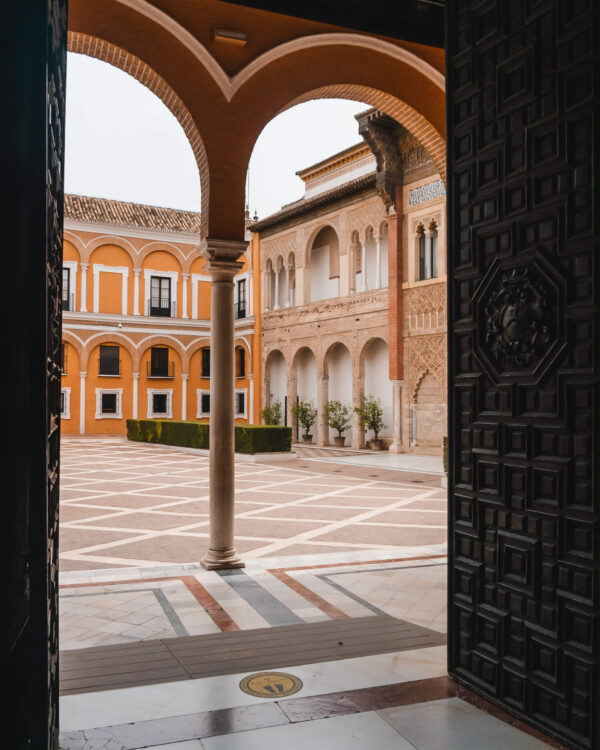
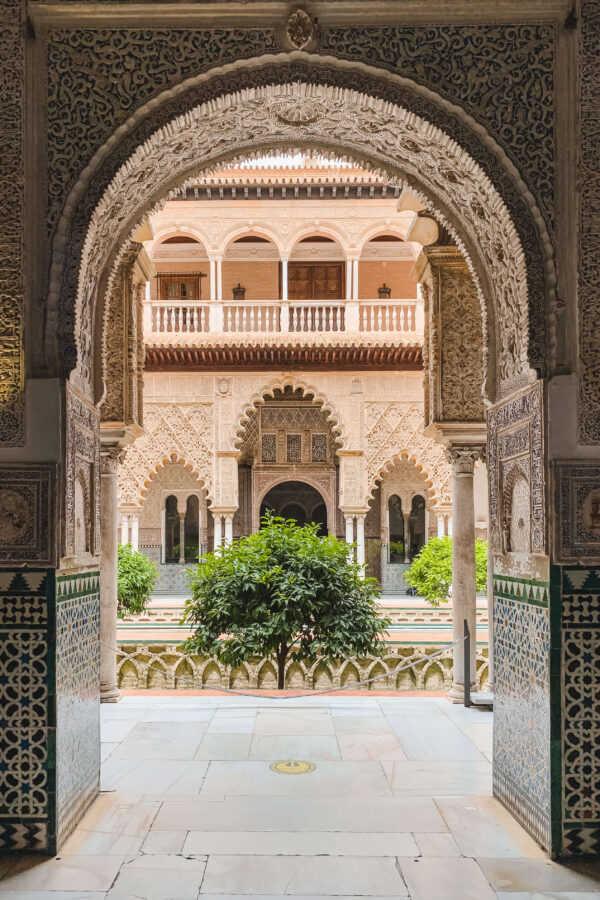

Etymology Fact: The Spanish term Alcázar comes from the Arabic al-qasr (اَلْقَصْر), meaning “a large stone building from which power is projected”. Interesting enough, the Arabic word itself actually comes from Latin castrum, meaning “fort”!
It’s a royal palace complex that has been continuously inhabited since the 10th century (and it’s the oldest royal palace in Europe that’s still inhabited!), which means the layers of architectural history here are seriously extraordinary. Moorish design, Gothic details, Renaissance additions… it’s all woven together like an architectural tapestry, and it’s stunning at every turn.

On screen: The Real Alcázar has appeared in several major productions. Game of Thrones fans will recognise it as the Water Gardens of Dorne in seasons five and six. It also featured as a location in Lawrence of Arabia (1962)!
The site’s history is layered in a way that makes it genuinely fascinating to explore, especially if you’re an architecture nerd like I am! The original structure was built by the Moorish governor of Seville in 913 AD, and subsequent rulers, both Moorish and Christian, expanded and adapted it over the centuries.
The result is a palace that moves fluidly between architectural styles: Moorish, Mudéjar, Gothic, Renaissance, and Baroque all coexist here, sometimes even within the same room. The dominant style is Mudéjar, a uniquely Iberian form of architecture that blends Islamic and Christian design.
Top Tip: Don’t spend too long in the earlier rooms. I made this mistake on my first visit, and by the time we reached the gardens we were too hungry and exhausted to properly appreciate them. Pace yourself, and make sure to save energy for the second half of the visit!
The complex is extensive, so here are some of the highlights to look out for specifically:
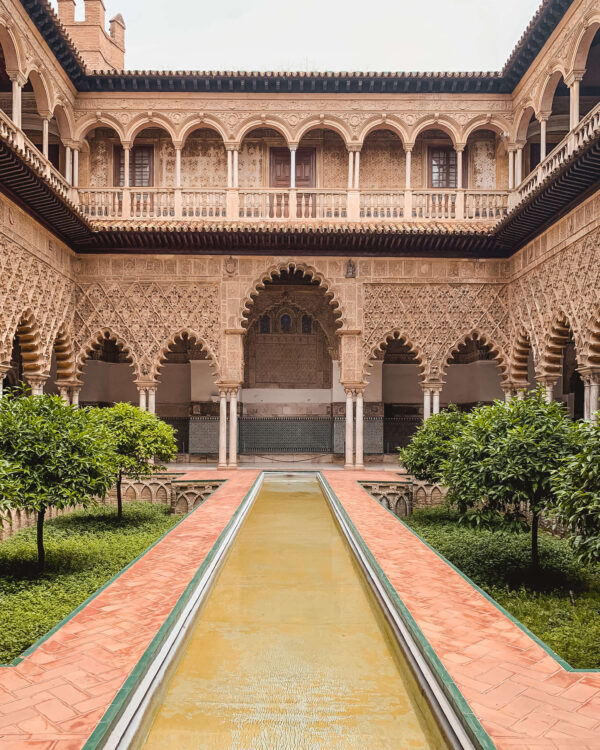
- Patio de las Doncellas (Court of the Maidens) is one of the most photographed spaces in Seville, and rightly so. The central reflecting pool surrounded by intricately carved stucco walls and double-arched galleries is a masterpiece of Mudéjar design.
- Salón de Embajadores (Hall of the Ambassadors) is the throne room, and it may be the single most impressive room in the entire complex. The domed ceiling is a spectacular gilded half-sphere decorated with interlocking geometric patterns, built in 1427. This is your reminder to remember to look up!
- The Gardens are vast, beautifully maintained, and a genuine highlight of the visit in their own right. They blend formal Renaissance design with wilder, more romantic sections, and there are peacocks wandering freely throughout.
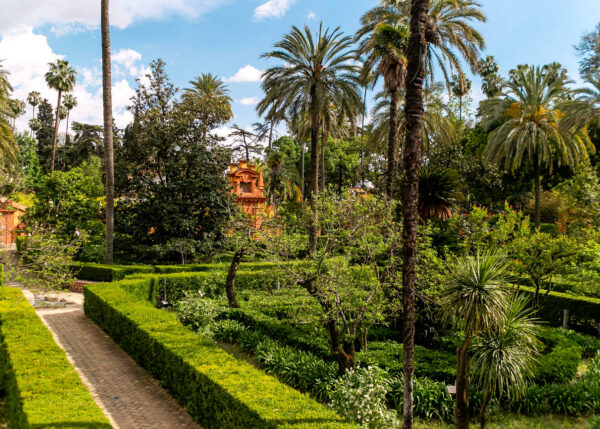
If you can, visit earlier in the morning or later in the afternoon. The midday sun is brutal (particularly in summer), and it also makes for terrible lighting (*cries in photographer*), so it’s worth timing your visit around the light if you can manage it.
The earliest entry is at 09:30, while the last entry is at 18:30 during summer (when the Alcazar closes at 19:00) and at 16:30 during winter (when the Alcazar closes at 17:00).
Book your tickets well in advance. I cannot stress this enough. The Alcázar sells out, often weeks ahead during peak season, and showing up on the day hoping for the best is a strategy that will leave you standing outside feeling very sorry for yourself.

Top Tip: you can also visit the Alcázar for FREE, but only on a Monday and only if you’re very prepared! The free Monday tickets tend to sell out two months or more in advance, and are for the last two time slots of the day (18:00 and 18:30 from April to September, and 16:00 and 16:30 the remainder of the year).
There are 345 tickets available for each time slot (which are every half hour from 09:30 until 30 minutes before closing), and the early entry tickets sell out very quickly. I recommend booking your tickets at minimum two weeks in advance during peak season (April through September), and at least one month in advance if you’re keen to get a specific (especially early) time slot.

Entry fee: €15.50 for general admission, with reduced entry tickets at €8.00 for those aged 65+ and for students (age 14-30) with valid student ID. Children under 14, as well as people with disabilities and their carer, can get free entry tickets, but you will still need to book these online. Book directly via the official Alcázar website here or via GetYourGuide.
Climb the Giralda Tower
📍 Address: Avenida de la Constitución, Casco Antiguo, 41004 Sevilla, Spain
🕜 Opening Hours: 11:00–19:00 Monday to Saturday; 14:30–19:00 Sunday.
💸 Cost: Combined Cathedral + Giralda ticket from €13; under-14s free; seniors and students 14–25 from €7
🗓️ Advance Booking? Yes, especially in peak season.
🎟️ Booking Tips: Book on the official website here OR on GetYourGuide for a guided tour.
⏰ Time needed: 1 – 1.5 hours, depending on your pace
☀️ Best Time to Visit: Earlier in the day or towards the end of the day
🗺️ Nearby Attractions: Seville Cathedral, Plaza del Cabildo, Archivo de Indias
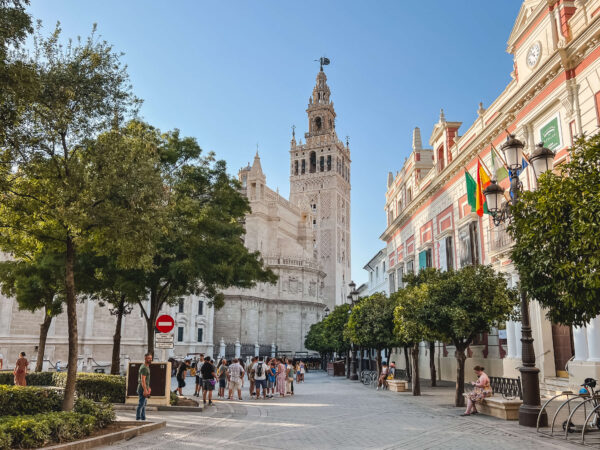
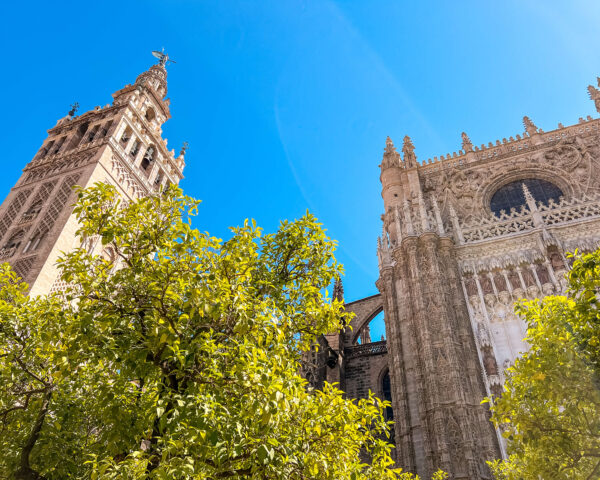
The Giralda is the bell tower of Seville’s Cathedral, and it’s worth every single step. Or rather, every single ramp, because here’s one of my favourite fun facts about Seville: the Giralda doesn’t have a traditional staircase. It has 35 ramps instead, a design that dates back to its original life as the minaret of a mosque, when the muezzin needed to reach the top on horseback. Yes, on horseback. Seville, everyone.
In practical terms, this means the climb is a different experience depending on your mobility. Many people find the ramps easier than steps, and I can see why. That said, I personally find a never-ending incline harder on my knees than stairs, so your opinion may vary. It’s worth knowing before you go, particularly if you have any mobility considerations.
Did you know? There’s a replica of the Giralda in Kansas City, Missouri! The city is twinned with Seville. Other replicas include the San Francisco Ferry Building and the Biltmore Hotel in Florida.
The views from the top over Seville’s rooftops are fantastic, and the tower is included in your Cathedral ticket, so there’s no reason to skip it.
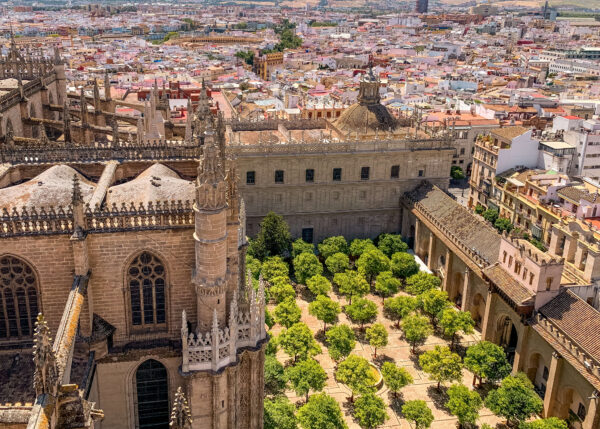
As with many churches and cathedrals in the south of Spain, what is now the Cathedral of Seville was once a mosque, hence why the bell tower was actually a minaret!
The Giralda is one of the most famous monuments of Moorish architecture in Spain and is considered to be one of the most refined examples of Almohad architecture. It was originally built as the minaret for the Great Mosque of Seville in Al-Andalus (yup, where the word “Andalucía” comes from) during the Almohad dynasty in the 12th century.
Entry fee: Combined Cathedral and Giralda tickets cost €13 (around £11 / $14). Book your entry ticket on GetYourGuide, or opt for a guided tour instead.
Seville Cathedral
📍 Address: Avenida de la Constitución, Casco Antiguo, 41004 Sevilla, Spain
🕜 Opening Hours: 11:00–19:00 Monday to Saturday; 14:30–19:00 Sunday.
💸 Cost: Combined Cathedral + Giralda ticket from €13; under-14s free; seniors and students 14–25 from €7
🗓️ Advance Booking? Yes, especially in peak season.
🎟️ Booking Tips: Book on the official website here OR on GetYourGuide for a guided tour.
⏰ Time needed: 1 – 1.5 hours, depending on your pace
☀️ Best Time to Visit: Earlier in the day or towards the end of the day
🗺️ Nearby Attractions: La Giralda, Plaza del Cabildo, Archivo de Indias
Seville’s Cathedral is the largest Gothic cathedral in the world, and standing inside it for the first time is one of those experiences that genuinely stops you in your tracks. It’s truly immense in a way that photos don’t quite prepare you for, and the scale of it only really hits once you’re inside looking up! It is, hands down, one of the best things to do in Seville, and you definitely shouldn’t skip it.
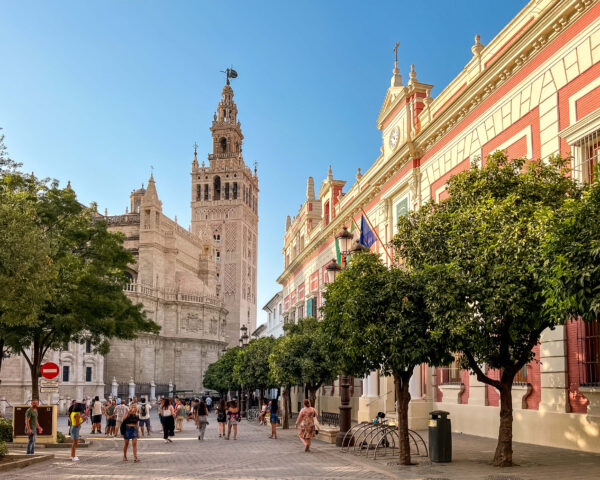
The Cathedral and the Giralda are sold as a combined ticket, and as with the Alcázar, booking ahead is essential. Don’t assume you’ll be able to walk in on the day. The queues for last-minute or on-the-door tickets can be long, and the pre-booked entry times are far smoother.
The actual name of the cathedral is the “Cathedral of Saint Mary of the See” (Spanish: Catedral de Santa Maria de la Sede), which I actually didn’t know until writing this guide! I don’t think I’ve ever heard anyone use this name when referring to it!
As with many cathedrals and churches in Spain, Seville Cathedral is built on a mosque from the 12th century. You’ll notice this to be a theme, particularly in the south of Spain.
The original structure was the Great Mosque of Seville, constructed in 1172 by the Almohad Caliphate, one of the most powerful Muslim dynasties of the medieval period. After the Christian Reconquest (Reconquista) of Seville in 1248, the mosque was converted for use as a cathedral, but it wasn’t until 1401 that the decision was made to tear it down and build something entirely new.
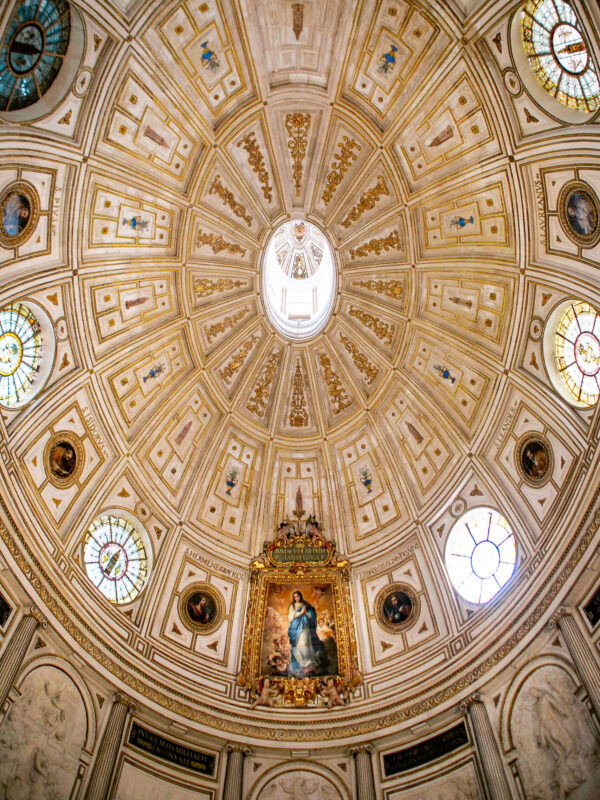
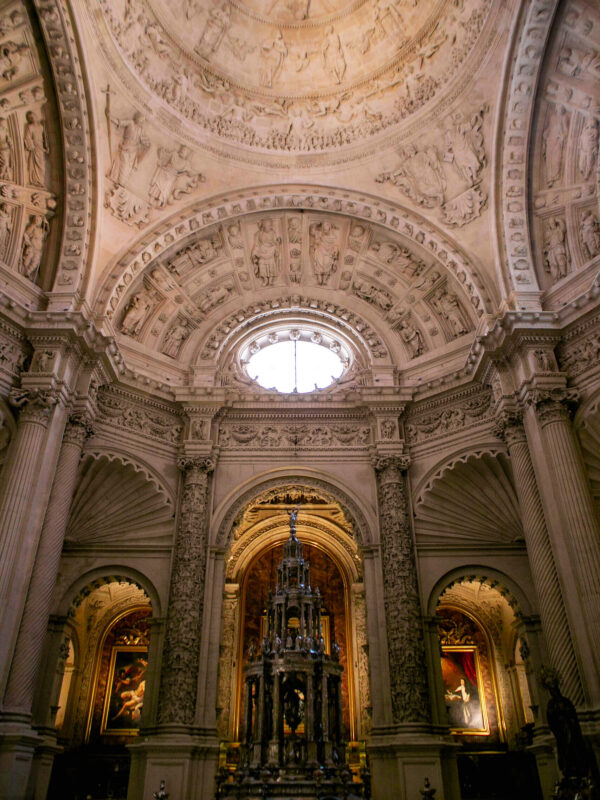
According to legend, the cathedral chapter declared: “Let us build a church so large that those who see it finished will think we were mad.” Fair enough, I guess!
Construction took over a century, completing in 1506, and the result is a cathedral so vast that it held the record as the world’s largest church for centuries. It was designated a UNESCO World Heritage Site in 1987, alongside the Alcázar and the Archivo de Indias.
Entry fee: Combined Cathedral and Giralda ticket from €13 (around £11 / $14). Under-14s free. Seniors and students aged 14–25 from €7. Book via the official Cathedral website or on GetYourGuide for a guided tour option.
Plaza de España
📍 Address: Avenida de Isabel la Católica, 41004 Sevilla, Spain
🕜 Opening Hours: Open 24 hours
💸 Cost: Free!
⏰ Time needed: 1–2 hours, more if you rent a boat
☀️ Best Time to Visit: Sunrise, or the hour before sunset
🗺️ Nearby Attractions: Parque de María Luisa, Museo Arqueológico de Sevilla
If there is one thing I will always tell people to do in Seville, it’s this: set your alarm, drag yourself out of bed, and visit the Plaza de España at sunrise.
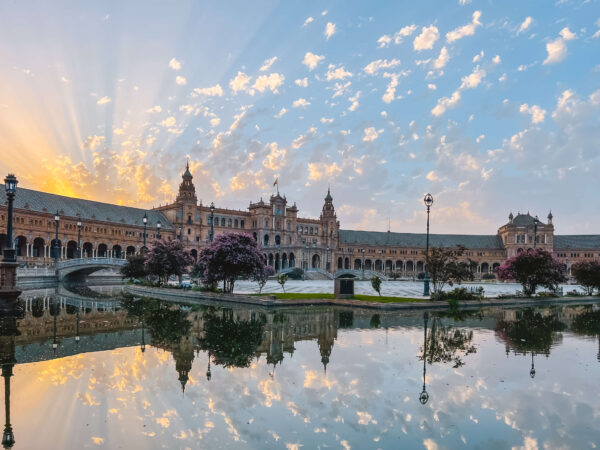
I know that sounds dramatic. But hear me out (and I HATE mornings).
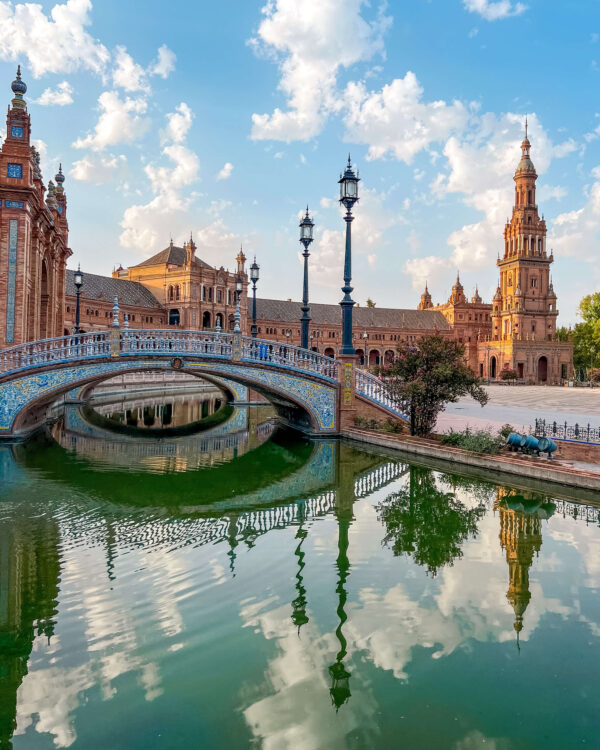
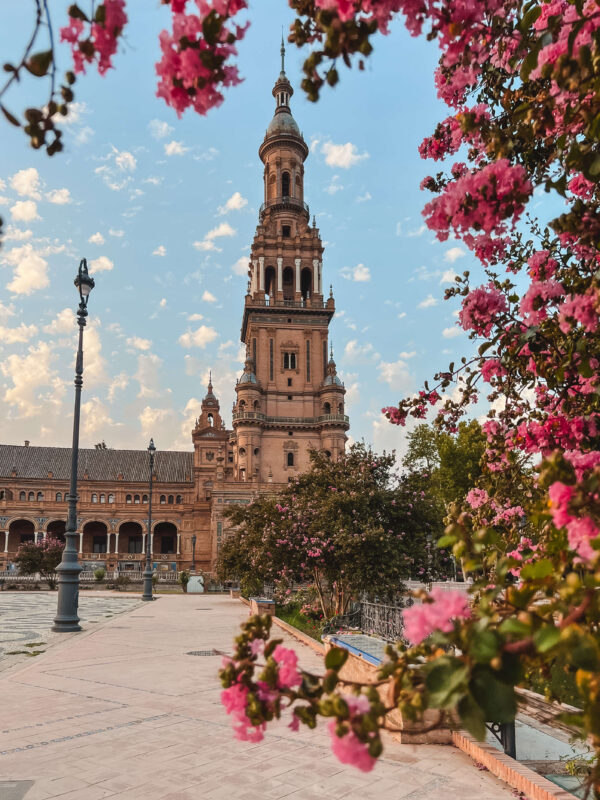
The Plaza de España is spectacular at any time of day. It’s a sweeping semicircular masterpiece built for the 1929 Ibero-American Exposition, with ornate tiled alcoves representing every province in Spain, a central canal with little rowing boats, and the kind of scale that makes you feel really small in the best possible way.
During the day, it’s busy. Like, very busy. But at sunrise, it’s almost empty, the light is extraordinary, and you get the whole thing practically to yourself in a way that feels almost surreal.
I did this on one of my visits and it remains one of my favourite Seville memories. I’d go back and do it again without hesitation.
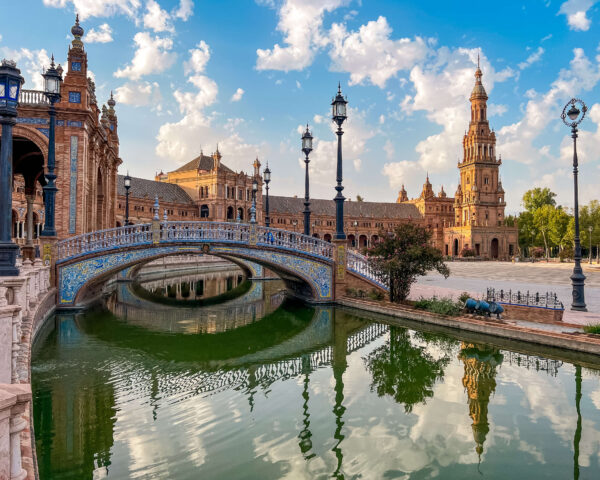
It’s also, for the record, completely free to visit, and open 24 hours a day (though it does occasionally close during bad weather, so worth checking on the day).
On screen: The Plaza de España has had some spectacular film cameos. It appeared as the planet Naboo in Star Wars: Episode II — Attack of the Clones (2002), in a scene where Senator Amidala, Anakin Skywalker, and R2-D2 cross one of the bridges and walk along the covered arcade. It also featured in Lawrence of Arabia (1962), making it one of the most filmed locations in Spain.
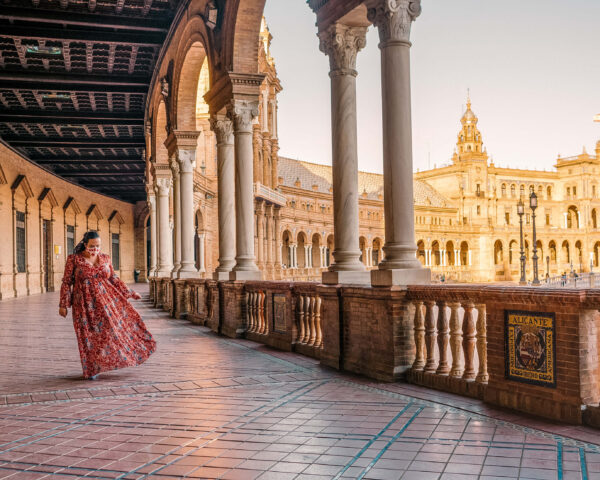
As I mentioned earlier, the Plaza was designed for the 1929 Ibero-American Exposition, a world fair celebrating Spain’s cultural and historical ties with Latin America, by Sevillian architect Aníbal González. Its semicircular shape is intentional: it symbolises Spain’s embrace of its former colonies (their former colonies may not have quite the same feeling, but we won’t go into that).
The building took 15 years to construct and was completed just one month before the Exposition opened. As someone with ADHD, that timeline feels strangely relatable…
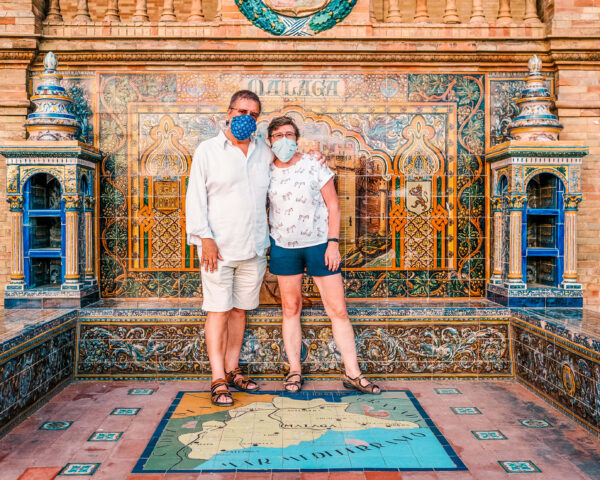
One of the most charming details of the Plaza is the 48 tiled alcoves lining the base of the building, each representing a different Spanish province. Every alcove features a hand-painted ceramic map of its province alongside a scene depicting a key historical event from its history. Make sure to take a look at them as you explore!
Entry fee: Free. Rowing boats cost approximately €6 for 35 minutes, payable at the on-site kiosk (cash or card). No advance booking available for boats.
Parque de María Luisa
📍 Address: Avenida de Isabel la Católica, 41004 Sevilla, Spain
🕜 Opening Hours: Open 24 hours
💸 Cost: Free!
⏰ Time needed: 45 minutes to 1.5 hours
☀️ Best Time to Visit: Morning or early evening
🗺️ Nearby Attractions: Plaza de España
Directly adjacent to the Plaza de España, Parque de María Luisa is one of those places that earns its spot on this list simply by being a really quite beautiful place. It’s large, beautifully maintained, and rather lovely to wander through, with shaded tree-lined paths, ornate tiled fountains, and the kind of peaceful atmosphere that feels almost incongruous given how central it is.
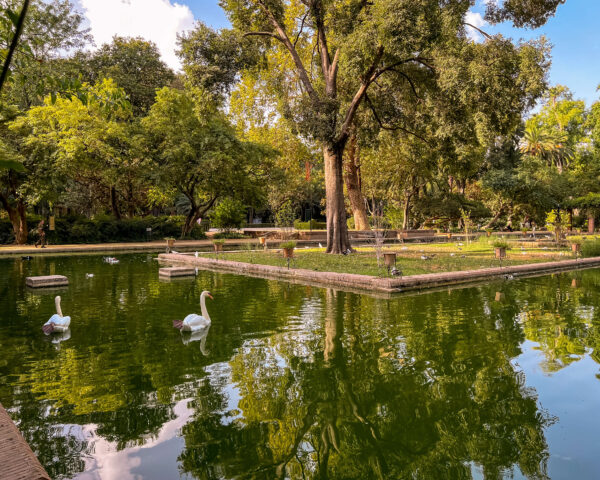
It’s free, it’s open all day, and it pairs perfectly with a Plaza de España visit. Allow at least an hour to wander properly, or more if it’s a hot day and you’re in no hurry to leave the shade.
Top Tip: The park is a lovely spot to pick up a snack or a cold drink and sit for a while. There are several kiosks and small cafés within the grounds, and finding a nice shaded bench to take a break from sightseeing is always appreciated, particularly in summer.
The park has a long history. It was originally part of the private gardens of the Palacio de San Telmo, and in 1893 Princess María Luisa of Bourbon donated half of the estate to the city of Seville as a public park, which is where the name comes from.
It was subsequently redesigned by French landscape architect Jean-Claude Nicolas Forestier ahead of the 1929 Ibero-American Exposition, and many of the decorative tiled elements and fountains you see today date from that period.
It’s absolutely worth visiting, and it’s one of the best free things to do in Seville!
Metropol Parasol (Las Setas)
📍 Address: Plaza de la Encarnación, Casco Antiguo, 41003 Sevilla, Spain
🕜 Opening Hours: Monday to Sunday, 09:30–00:30 (final access at 23:45)
💸 Cost: €16 adults; €13 reduced (65+, children aged 6–14, EU students aged 18–25); free for children under six
🗓️ Advance Booking? Recommended! Book your tickets here.
⏰ Time needed: 45 minutes to 1 hour
☀️ Best Time to Visit: Late afternoon or around sunset for the best light on the walkway
🗺️ Nearby Attractions: Plaza de la Encarnación, Iglesia de la Anunciación
Let’s address the obvious straight away: the Metropol Parasol looks like a giant wooden mushroom landed in the middle of one of Spain’s most historic city centres (hence the alternative name, “Las Setas”).
Depending on who you ask in Seville, this is either a bold and brilliant piece of contemporary architecture or an absolute affront to the city’s skyline. Sevillanos, it’s fair to say, have strong feelings about it. The debate has been running since it opened in 2011 and shows absolutely no sign of cooling down.
My own take? It’s worth visiting. Whether you end up loving it or finding it deeply odd, it’s a genuinely unique piece of architecture and one of the largest wooden structures in the world, which is impressive by any measure.
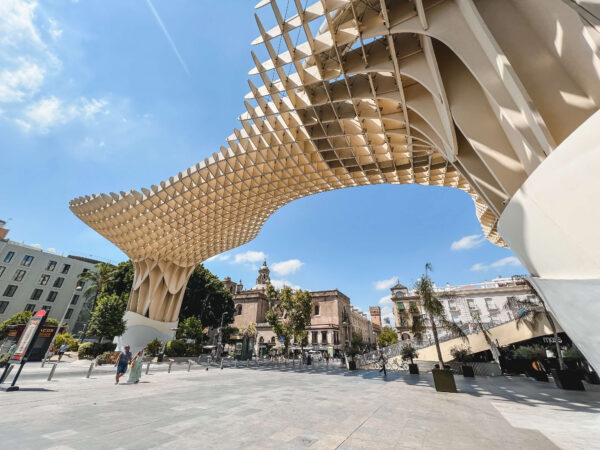
Top Tip: The market at ground level, the Mercado de la Encarnación, operates in the mornings until early afternoon, and is a good stop if you’re passing through. You’ll find local produce, fresh food, and multiple cafes and restaurants.
The Metropol Parasol was designed by German architect Jürgen Mayer and took nearly a decade to complete, opening in 2011 after significant construction delays and cost overruns that did not exactly endear it to the local population in the slightest. The structure stands 27 metres tall and covers an area of around 150 metres by 70 metres, its undulating canopy supported by six enormous mushroom-shaped columns. The design was intended to create a shaded public space in the heart of the city, and whatever you think of the aesthetics, it does indeed do that effectively.
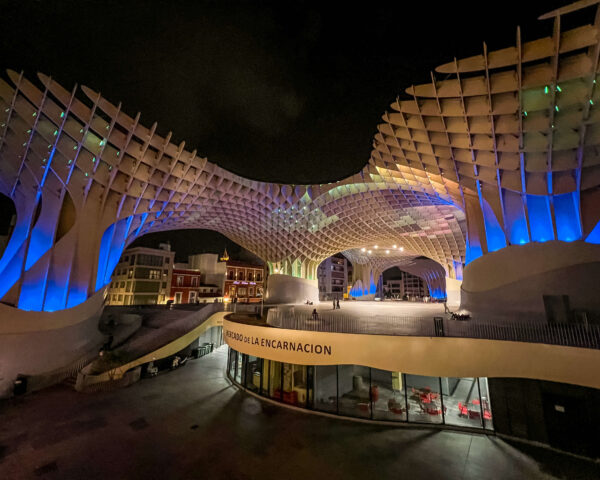
The name Las Setas (the mushrooms) was coined by locals, and Seville officially adopted the name Setas de Sevilla after discovering the project’s architect had trademarked the name “Metropol Parasol” and would charge for its use!

Tip: One really unique place to stay is Hotel Casa de Indias by Intur! It’s located right on the Plaza de la Encarnación, and you can book a room with a view of the Setas. I did this on a recent trip to Sevilla and it’s such a great view, plus you get to see Las Setas at all different times of day! Check availability and prices for Hotel Casa de Indias by Intur here.
The highlight for most visitors is the Mirador 360º, a winding walkway that snakes across the top of the structure and gives you panoramic views over Seville’s historic centre. I went up around 8pm (during May, when sunset was around 9:30pm), and the views were great, so I highly recommend timing it to visit during the late afternoon or around sunset for better light.
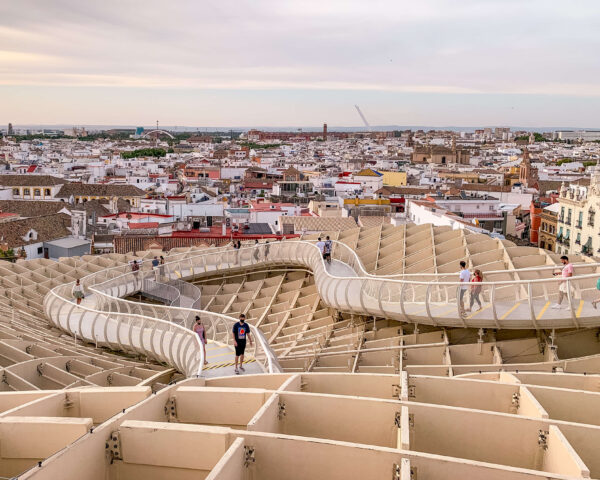
The walkway itself is interesting to walk because the structure looks completely different from up close than it does from street level!
Your ticket includes access to the 360º viewpoint, a multisensory film called Feeling Sevilla, the Aurora light show, an audio guide, and free WiFi.
Entry fee: €16 adults; €13 reduced rate (65+, children aged 6–14, EU students aged 18–25); free for children under six. Your ticket includes the Mirador 360º walkway, the Feeling Sevilla multisensory film, the Aurora light show, audio guide, and free WiFi. Book your entry tickets here!
The Antiquarium
Beneath the structure, at basement level, is the Antiquarium, an archaeological museum containing Roman and Moorish remains discovered during construction of the Metropol Parasol. The excavations uncovered a remarkably well-preserved section of Roman Seville, including mosaics, fish-salting tanks, and domestic structures dating back to the 1st century AD.
I haven’t visited the Antiquarium myself, but by all accounts it’s a genuinely interesting addition to the visit and well worth the time if ancient history is your thing.
Plaza del Cabildo
📍 Address: Plaza del Cabildo, Casco Antiguo, 41001 Sevilla, Spain
🕜 Opening Hours: Open 24 hours
💸 Cost: Free
⏰ Time needed: 15-20 minutes (longer if you want to explore the shops in the square)
☀️ Best Time to Visit: Any time; Sunday mornings if you want to catch the market
🗺️ Nearby Attractions: Seville Cathedral, Archivo de Indias
This is one of those spots that a surprising number of visitors walk straight past, despite being just a few steps from the Cathedral.
Plaza del Cabildo is a small, semicircular arcaded square tucked just off the Avenida de la Constitución, and it has a calm, almost secretive quality that feels completely at odds with how central it actually is. The entrances are easy to miss — just a quiet archway between buildings — which is exactly why so many people walk right past it.
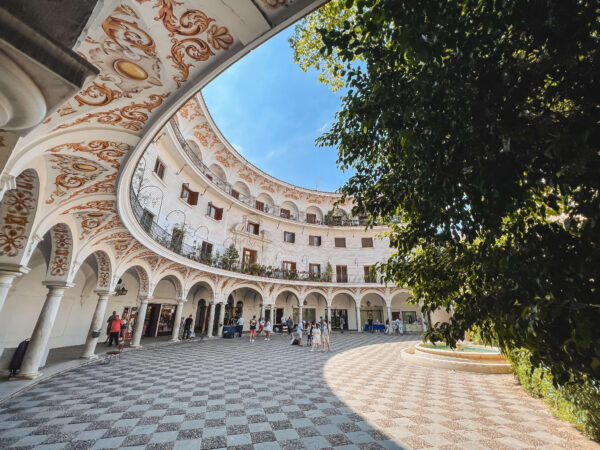
Once you’re inside, it’s immediately clear why it’s worth seeking out. The arcade is lined with marble columns, the ground floor decorated with frescoed panels by Sevillian painter José Palomar, and there’s a small fountain at the centre that you’ll hear before you see.
Top Tip: The shop Dulces El Torno inside the arcade sells traditional sweets and food products made by nuns from Seville’s convents, including egg-yolk sweets (yemas) from Convento Santa Clara and Convento San Leandro, and jam from Convento Santa Paula. It’s a lovely selection of local items to pick up!
The plaza was built in the mid-20th century on the site of the former Colegio de San Miguel, which belonged to the Cathedral’s governing council (the Cabildo, which is where the square gets its name). Several of the original school’s marble columns were incorporated into the new structure.
One of the most interesting details is the section of Almohad wall that runs along the straight side of the square, dating from 1184. It predates the Giralda by 14 years, and it’s just happily sitting there while tourists queue for the Cathedral around the corner, completely unaware.
It’s definitely a highlight of the free things to do in Seville!
The Sunday market
On Sunday mornings from 09:00–14:00, the plaza hosts the Mercadillo de la Plaza del Cabildo de Coleccionismo, a small collectors’ market that has been running here since 1997.
Vendors set up tables selling coins, stamps, banknotes, old postcards, medals, minerals, and various other collectibles. It’s a niche crowd, but the atmosphere is lovely. Even if you have no interest in coin collecting, it’s worth timing a Sunday morning visit here just for the atmosphere.
Who knows, maybe you’ll end up with a unique philatelic (philately is the study of postage stamps and postal history) or numismatic (numismatics is the study and collection of currency, including coins, tokens, medals, and paper money) souvenir!
Explore the Museo de Bellas Artes
📍 Address: Plaza del Museo, 9, Casco Antiguo, 41001 Sevilla, Spain
🕜 Opening Hours:
💸 Cost: €1.50 for non-EU visitors; free for EU citizens
🗓️ Advance Booking? No (buy your ticket at the museum)
⏰ Time needed: 1–1.5 hours
☀️ Best Time to Visit: Weekday mornings tend to be quietest
🗺️ Nearby Attractions: Alameda de Hércules
I’ll be upfront: I’m not really an art museum kind of person. But the Museo de Bellas Artes won me over, and the reason is almost entirely the building itself.
Housed in a stunning 17th-century former convent, the Convento de la Merced Calzada, the museum is one of the most beautiful buildings in Seville — which is a city that sets an extraordinarily high bar for beautiful buildings. The central courtyard is gorgeous, the chapel that now serves as the main gallery space is breathtaking, and the whole place has an atmosphere that feels genuinely peaceful rather than the slightly institutional feeling that art museums can sometimes have. Even if you’re not particularly moved by Spanish Baroque painting, the architecture alone makes a visit worthwhile.
That said, the collection is pretty darn impressive if art is your thing. The Museo de Bellas Artes is widely considered one of the finest art museums in Spain outside of Madrid, with a permanent collection focused heavily on Spanish Baroque painting from the 16th to 19th centuries.
The standout names are Bartolomé Esteban Murillo, who was born in Seville and whose work features prominently throughout, and Francisco de Zurbarán, whose dramatic use of light and shadow is immediately distinctive. There are also works by Juan de Valdés Leal and, in the earlier rooms, pieces from the medieval and Renaissance periods that trace the full arc of Andalusian artistic history.
Free entry days
Beyond the standard EU citizen exemption, the museum also offers free entry on the following dates each year regardless of nationality: 28 February (Día de Andalucía), 18 May (International Museum Day), 27 September (World Tourism Day), and 4 December (Día de la Bandera Andaluza), as well as during the European Heritage Days.
Entry fee: €1.50 for non-EU visitors. Free for EU citizens with valid ID, ICOM members, and on designated free days throughout the year (see above).
Looking for more amazing places to visit in Andalucía? Make sure to read my guide on the best hidden gems in Andalucía!
Casa de Pilatos
📍Address: Plaza de Pilatos, 1, 41003 Sevilla, Spain
🕜Opening Hours: Daily 09:00–18:00. Last entry 30 minutes before closing.
💸Cost: €12 for general admission, free entry for children under 12.
🗓️Advance Booking? Not always necessary, but useful during peak season.
⏰Time needed: 1.5–2 hours
☀️Best Time to Visit: Weekday mornings for fewer crowds
🗺️Nearby Attractions: Las Setas, Iglesia del Salvador
Casa de Pilatos is the largest private palace in Seville and is widely considered the finest example of Andalusian civil architecture in the city. It has been the residence of the Dukes of Medinaceli for centuries and is still partly inhabited by the family today, which gives the whole place an atmosphere that feels genuinely lived-in rather than purely preserved for tourism.
Entry fee: Tickets cost €12 and you can purchase them here on GetYourGuide! Children under 12 get free entry.
Full disclosure: Casa de Pilatos is on my list of places I’m yet to visit myself (something I intend to rectify on my next trip), but it’s earned its place here based on everything I know about it.
Construction began in the late 15th century under Pedro Enríquez de Quiñones, the Chief Governor of Andalucía, and was continued and significantly expanded by his son Fadrique Enríquez de Ribera, the 1st Marquis of Tarifa, in the early 16th century. The palace’s unusual name — Casa de Pilatos, or Pilate’s House — comes from an interesting historical quirk. After Fadrique completed a pilgrimage to Jerusalem in 1519, he was struck by the resemblance between his palace and descriptions of the house of Pontius Pilate. He established a Via Crucis (Stations of the Cross) with the palace as the starting point, representing Jesus leaving Pilate’s house, and the name stuck.
The palace was declared a National Monument in 1931 and remains one of the most significant examples of 16th-century Sevillian architecture in existence.
On screen: Casa de Pilatos has appeared in several major productions, including Lawrence of Arabia (1962), 1492: The Conquest of Paradise (1992), Kingdom of Heaven (2005), Knight and Day (2010), and The Crown.
What makes Casa de Pilatos so remarkable is the way it blends architectural traditions that don’t, on paper, belong together at all. Gothic, Mudéjar, and Italian Renaissance styles coexist throughout the complex, a reflection of the Enríquez de Ribera family’s close cultural ties with Italy and their deep roots in Andalusian tradition. The result is a palace that manages to feel both grand and intimate, layered with detail at every turn.
The main courtyard (Patio Principal) is the centrepiece of the visit and one of the most beautiful spaces in Seville. It features a central fountain, classical Roman statues, intricate Mudéjar tilework, and delicately carved stucco arches.
The upper floor, which houses the family’s private collection of furniture, tapestries, and paintings including works by Goya, can only be visited on a guided tour.
Palacio de las Dueñas
📍 Address: Calle Dueñas, 5, Casco Antiguo, 41003 Sevilla, Spain
🕜 Opening Hours: 10:00–18:00 (October to March) and 10:00–19:00 (April to September). Last entry 45 min before closing.
💸 Cost: €15 for general admission, €11 reduced ticket (children 6-16, students 25 and under, seniors 65+). Free entry for children under 6.
🗓️ Advance Booking? Not necessary, but recommended during peak season.
🎟️ Booking Tips: Book your entry ticket online here or book your ticket with a guided tour here.
⏰ Time needed: 1–1.5 hours
☀️ Best Time to Visit: One to two hours before closing for the best light in the courtyards
🗺️ Nearby Attractions: Las Setas
If you only visit one palace in Seville beyond the Alcázar, make it this one! For me, the Palacio de las Dueñas is easily one of the best things to do in Seville beyond the Alcázar and the Cathedral.
Palacio de las Dueñas is the Seville home of the House of Alba, one of Spain’s most storied and prominent noble families, and it is absolutely spectacular. It opened to the public in 2016 and has become one of Seville’s most loved palace visits. There’s art on the walls, personal photographs on side tables, and a sense of real life running through the rooms that makes the whole experience feel unusually intimate.
The palace was built between the 15th and 16th centuries on the site of the former Monastery of Santa María de las Dueñas, from which it takes its name. It was originally owned by the Pineda family, who were forced to sell it urgently after one of their own was kidnapped and they needed to raise the ransom. After the marriage of the 5th Marchioness of Villanueva del Río to the 4th Duke of Alba in 1612, it passed into the hands of the House of Alba and has remained there ever since.
Top Tip: Free entry is available on non-holiday Mondays from 16:00 until closing, but tickets must be booked in advance on the official website as capacity is limited. Once capacity is reached, access is not permitted.
Over the centuries the palace has welcomed an extraordinary roster of visitors: Jacqueline Kennedy, Grace Kelly, Rainier of Monaco, Alfonso XIII, and Wallis Simpson among them. It was also the favourite Sevillian residence of Cayetana de Alba, the charismatic 18th Duchess of Alba, who died in 2014 and whose presence still feels very much alive throughout the palace.
Entry fee: €15 general; €11 reduced. Free for children under six and on non-holiday Mondays from 16:00. Book your entry tickets here, or through GetYourGuide for a guided tour option.
The poet Antonio Machado, one of the most celebrated figures in Spanish literature, was born here in 1875, when his father worked as an administrator for the Duke of Alba. There’s a small tribute to him within the palace.
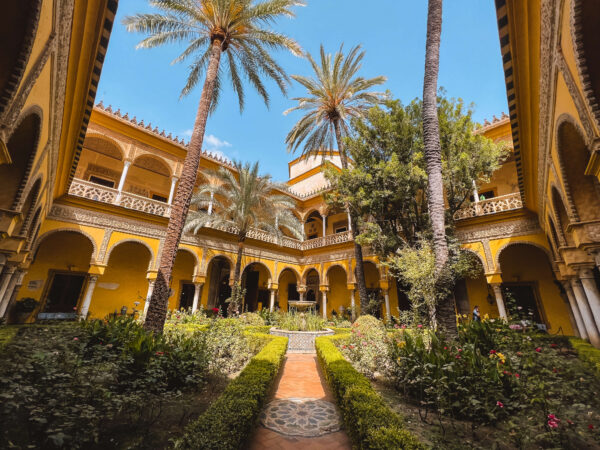
The palace is a beautiful example of Gothic-Mudéjar and Renaissance architecture, built around a series of courtyards and gardens that open up one after another as you move through the complex. The central courtyard is particularly lovely and my personal favourite — vibrant yellow walls, Mudéjar arches, ornate tilework, and lush planting that gives the whole space a warmth and colour that feels distinctly Sevillian rather than formally palatial.
Top Tip: Visit one to two hours before closing. The light in the courtyards at that time of day is really beautiful, and the crowds thin out considerably in the final hour since the last entry is 45 minutes before closing. It makes for a much more relaxed and photogenic visit than the busy midday period.
Palacio de la Condesa de Lebrija
📍 Address: Calle Cuna, 8, Casco Antiguo, 41004 Sevilla, Spain
🕜 Opening Hours:
💸 Cost: €15 for general admission, €8 for children aged 6-12. Free entry for children under 6.
🗓️ Advance Booking? Not required.
🎟️ Booking Tips: Book your ticket in advance on the official website and choose the best time slot!
⏰ Time needed: 1–1.5 hours
☀️ Best Time to Visit: Weekday mornings (excluding Friday) for the quietest experience.
🗺️ Nearby Attractions: Las Setas
This one is quite a hidden gem in Seville, and I say that as someone who is usually quite sceptical of that phrase (it definitely gets misused). While most people know about the Casa de Pilatos and everyone’s off to the Alcazar, many people never hear about this palace or add it to their Seville itinerary.
The Palacio de la Condesa de Lebrija (Palace of the Countess of Lebrija) is a 16th-century palace tucked along Calle Cuna, one of the streets running parallel to the famous Calle Sierpes shopping street, and the vast majority of visitors to Seville walk straight past it without ever knowing it exists.
The palace was originally a typical Sevillian mansion, and in 1901, it was purchased by Regla Manjón Mergelina, the Countess of Lebrija, a woman of considerable passion, intellect, and archaeological ambition. She spent the following decades transforming the palace into a showcase for her extraordinary collection, which she had amassed through a lifetime of travel and excavation.
By the time she was finished, she had installed Roman mosaics from the nearby ancient city of Italica directly into the floors of the palace’s main rooms, lined the walls with 16th-century azulejos salvaged from ruined convents, and filled the space with classical statues, Louis XIV and Louis XVI furniture, Persian ceramics, Greek and Etruscan artefacts, and paintings from the Murillo school and beyond.
Entry fee: €15 for general admission, €6 for children aged 6-12, and free entry for children under 6. The ticket also includes the guided upper floor tour. You can book online at the palace’s official website to guarantee your guided tour slot, or purchase your ticket upon arrival to the palace.
Frommer’s Guide to Seville describes the Countess as “a formidable woman who knew exactly what she wanted,” and looking at what she built, it’s very hard to argue with that assessment. Considering it was also in an era that women were still prevented from participating in scholarly pursuits, it’s even more impressive to see what she built.
The heart of the visit is the main patio, and it is extraordinary. The floor is covered in a near-flawless Roman mosaic dating from the 2nd and 3rd centuries AD, excavated from Italica and featuring depictions of the god Pan. The Mudéjar arches surrounding the courtyard are lined with traditional Triana azulejos, and the overall effect is one of the most visually striking interiors I’ve seen in Seville.
The ground floor can be explored independently at your own pace and includes the main patio, a series of rooms displaying the Countess’s collection of Roman and ancient artefacts, ceramics, sculpture, and decorative arts. It’s really beautiful!
The upper floor, which includes the family’s private living quarters, an impressive carmine-coloured library, a chapel, and rooms decorated in Arabic and Asian styles, can only be visited on a guided tour. The guided tour is included in your ticket and they happen regularly throughout the day.
Archivo General de Indias
📍 Address: Avenida de la Constitución, Casco Antiguo, 41004 Sevilla, Spain
🕜 Opening Hours: Closed Mondays. Open Tuesday to Saturday 09:30–16:30 and Sunday 10:00–13:30.
💸 Cost: Free!
⏰ Time needed: 30 minutes – 1 hour
☀️ Best Time to Visit: Weekday mornings (except Mondays)
🗺️ Nearby Attractions: Real Alcázar, Seville Cathedral, Plaza del Cabildo
So many visitors walk straight past the Archivo de Indias and this is, in my opinion, one of the biggest mistakes you can make in Seville.
I understand why it happens. It sits between the Cathedral and the Alcázar, two of the most visited monuments in Spain, and most people are either heading to one or recovering from the other. The building’s exterior, though beautiful, is relatively understated, at least compared to its neighbours.
But if you’ve ever been curious about how Seville became the most powerful city in the world during the 16th century, this is the place that explains it better than anywhere else.
Entry fee: Free! No advance booking required. Closed Mondays. However, you can also book a guided tour of the Archivo de Indias, which is ideal if you’d like to learn more about the history of Spain and its colonies.
The building itself dates to 1572, commissioned by King Philip II and designed by Juan de Herrera, the same architect responsible for the austere grandeur of El Escorial near Madrid. It was originally built as the Lonja de Mercaderes, the Merchants’ Exchange of Seville, a dedicated space for the traders who were conducting the booming business of colonial commerce with the Americas.
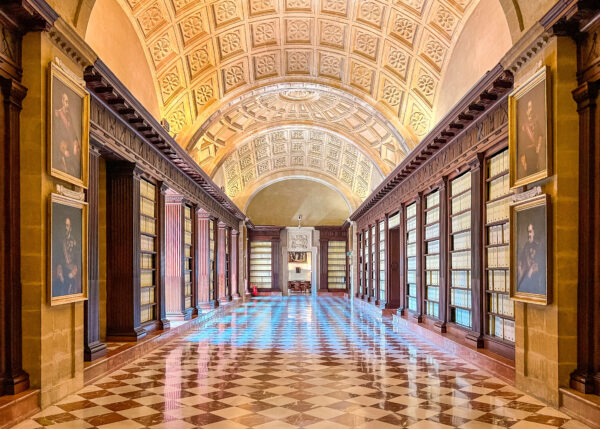
The archive was established in 1785 by order of King Charles III, who wanted to centralise all documentation relating to Spain’s administration of its territories in the Americas and the Philippines in a single location. Documents were gathered from archives in Simancas, Cádiz, Madrid, and Seville itself, and what exists here today is the most comprehensive record of the Spanish Empire in the New World on earth.
The scale of what’s held here is genuinely staggering. The archive contains over 43,000 files, 80 million pages of documents, and 8,000 maps, stored across more than nine kilometres of shelving. The collection includes original handwritten letters and journals from Christopher Columbus, Ferdinand Magellan, Hernán Cortés, Francisco Pizarro, and Vasco Núñez de Balboa.
The original Treaty of Tordesillas — the 1494 papal agreement that divided the newly discovered world between Spain and Portugal — is housed here. These documents are not on permanent public display, as they are preserved under strict archival conditions, but they appear in temporary exhibitions throughout the year.
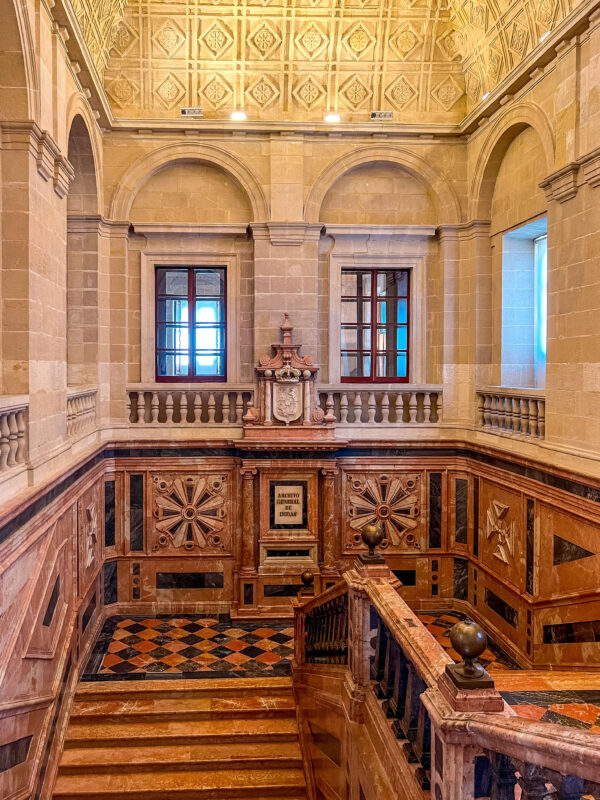
The visit is free and takes around 30 to 45 minutes at a comfortable pace. You enter through the main lobby, pass a quick security check, and emerge into a beautiful square courtyard surrounded by two-storey arcaded galleries that flood the interior with light. The main staircase, dating from 1786, is spectacular; decorated with red, grey, and black jasper from Málaga and topped by a lantern dome.
The permanent display includes rotating exhibitions of documents from the collection, portraits of explorers and colonial administrators, and contextual material about the history of the Spanish Empire. Much of the signage is in Spanish only, which is worth knowing in advance, but the building is worth the visit regardless.
Top Tip: The Archivo is not a traditional museum with a static permanent exhibition — what’s on display changes as the archive rotates its temporary shows. The building alone justifies the visit, but checking the current exhibition on the official website before you go means you’ll have some context for what you’re looking at.
Torre del Oro
📍 Address: Paseo de Cristóbal Colón, Casco Antiguo, 41001 Sevilla, Spain
🕜 Opening Hours: Open Monday to Friday 09:30–19:00 and Saturday and Sunday 10:30–19:00.
💸 Cost: Free, but a donation is required. €5 is the suggested amount.
⏰ Time needed: 30-45 minutes
☀️ Best Time to Visit: Late afternoon for the golden light on the tower and reflections on the river
🗺️ Nearby Attractions: Archivo de Indias, Triana riverside walk
The Torre del Oro is one of Seville’s most recognisable landmarks, and it earns that status as much for what it has witnessed as for how it looks. This 13th-century watchtower has been standing on the banks of the Guadalquivir for over 800 years, and in that time it has served as a military fortification, a royal chapel, a prison for nobles, a gunpowder store, and the point from which ships laden with gold and silver from the Americas entered the city. It is now a Naval Museum, and it’s a great deal more interesting than it might initially sound.
I’ll be honest with you, I haven’t been inside myself. What I can tell you is that the exterior alone is worth your time, particularly in the late afternoon when the tower catches the light and earns its name in a way that’s striking. The riverside walk along the Paseo de Cristóbal Colón is lovely from this side of the river, and the views back towards the city from near the tower are among the best you’ll get at ground level.
Top Tip: Late afternoon is the best time to visit for photos of the exterior. The tower glows in warm light and the river reflections at that hour are beautiful. It’s one of the most photographed spots in Seville for good reason.
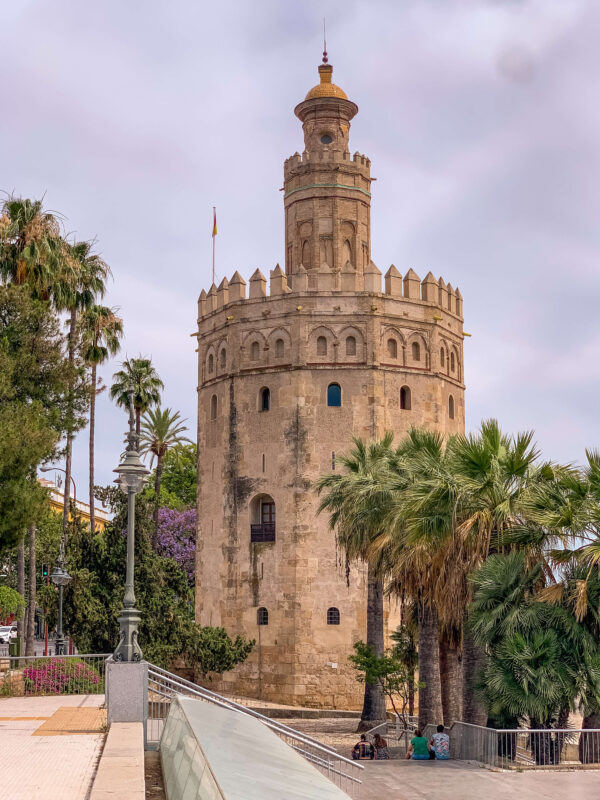
The museum is spread across two floors and a rooftop terrace. The ground floor covers the history of the tower itself and Seville’s role in the Carrera de Indias, the trade route between Spain and the Americas, including a model of the Real Fernando, the first steamship built in Spain. The first floor traces the evolution of the Spanish Navy with nautical charts, navigation instruments, ship models, and documents related to the Age of Exploration, including Magellan and Elcano’s first circumnavigation of the globe. The rooftop terrace offers panoramic views over the Guadalquivir, across to Triana, and back towards the Cathedral and Giralda.
Note that the tower has narrow, winding staircases and no lift, making the upper levels inaccessible for visitors with mobility limitations. The ground floor is accessible.
Entry fee: If you’d prefer to visit the Torre del Oro and many other of Seville’s important landmarks on a guided tour, then you should look at the Age of Discoveries Guided Tour. It includes entry to the Torre del Oro and Archivo de Indias, plus visits to many other monuments that were key when Seville was the economic heart of the Spanish Empire, and the primary port connecting Europe to the Americas.
Best Free Things To Do in Seville
One of the best things about Seville is that you can enjoy a lot of the city without spending much. Some of the most memorable first-time experiences are completely free!
|
Free Thing to Do |
Why It’s Worth It |
Best Time to Go |
|---|---|---|
|
Plaza de España |
Iconic architecture and photos |
Morning or golden hour |
|
Parque de María Luisa |
Shade, gardens, slower pace |
Afternoon or after Plaza de España |
|
Plaza de Cabildo |
Pretty hidden-feeling square |
Anytime near Cathedral visit |
|
Archivo de Indias |
Historic building near major sights |
Before/after Cathedral or Alcázar |
|
Riverside walk near Torre del Oro |
Views, fresh air, Triana views |
Sunset |
|
Exterior views of Cathedral and Giralda |
Major landmarks without ticket |
Morning or evening. I particularly love the view from Calle Mateo Gago! |
Where To Eat in Seville
Seville is a tapas city, and eating here is very much part of the experience rather than just a practical stop between attractions. The city has a vibrant food culture, and the quality of even a casual lunch at a side-street bar can be very good.
Before we get into specific recommendations, there are two dishes you really shouldn’t leave Seville (or, to be more precise, Andalucía) without trying. The first is salmorejo, a cold, thick tomato and bread soup that’s similar to gazpacho but richer and (in my personal opinion) considerably better. It’s typically topped with hard-boiled egg and cured ham, and it appears on almost every menu in the city.
The second is flamenquín, a dish unique to Andalucía: pork loin rolled with jamón serrano, then breaded and deep-fried. It sounds simple and it is, but it’s seriously delicious. Just don’t eat too many, otherwise your doctor probably wouldn’t be best pleased!
Best Tapas Spots in Seville
Casa Tomate
📍 Address: Calle Mateos Gago, 24, Casco Antiguo, 41004 Sevilla, Spain
🕜 Opening Hours: Open daily 12:00–00:00
💸 Cost: Around €10-20 per person
Casa Tomate (yes, its name does indeed translate to “Tomato House”) is one of those places that gets most things right at once: good food, a great atmosphere, and a location that’s incredibly central given how close it is to the Cathedral. It’s the kind of spot that works equally well for a casual lunch or a longer, lazier dinner, and it draws a good mix of locals and visitors without feeling like it’s aimed exclusively at drawing in tourists.
The menu leans into modern Andalusian cooking rather than sticking strictly to the classics. On our visit we had grilled octopus with truffled potato cream, pork sirloin (solomillo) in a whisky sauce, huevos rotos with ibérico ham and chips, and carrillada (slow-cooked pork cheek), which was the standout of the meal. The food is confident without being showy, and the portions are generous by tapas standards.
Top Tip: Casa Tomate is very well located for combining with an evening visit to the Cathedral area or the Archivo de Indias on your way back. It makes a natural end point to a day of sightseeing in the historic centre.
No booking required, just turn up. It does get busy, particularly in the evenings, so arriving slightly ahead of peak time can work in your favour.
Perro Viejo
📍 Address: Calle Arguijo, 3, Casco Antiguo, 41003 Sevilla, Spain
🕜 Opening Hours: Open Monday to Thursday 13:00–16:00 and 20:00–23:00 and Friday to Sunday 13:00–16:00 and 20:00–00:00
💸 Cost: Around €15-30 per person
Perro Viejo is tucked down a side street, which keeps it a little quieter than some of the more central tapas spots and gives it a more relaxed, neighbourhood feel. We visited for lunch, and it was a great accidental find as we were just looking for something near to where we’d just been (Palacio de la Condesa de Lebrija) that wasn’t completely and utterly rammed with people.
You can also book a table in advance, which is ideal if you want to make sure you won’t be waiting around, or if you’re travelling in a larger group.
The menu is interesting because it covers a wider range than you might expect. There are the Andalusian classics — salmorejo, croquetas, that kind of thing — but also some more creative dishes alongside them. We had the taco Mexicali de merluza frita con crema de aguacate (a fried hake taco with avocado cream that was seriously delicious), ensaladilla clásica de langostinos (a traditional egg and potato salad topped with prawns, simple and very good), and pollo yakitori con trigo de bulgur. The range shouldn’t work as well as it does, and yet it does.
It’s a good choice if you want something slightly off the main tourist circuit without sacrificing quality.
Best Brunch Restaurants in Seville
La Mala Brunch
📍Address: Calle Rivero, 7, Casco Antiguo, 41004 Sevilla, Spain
🕜Opening Hours: Open daily 09:00–19:00
💸Cost: Around €10-20 per person
La Mala Brunch has a few locations across Seville, which tells you something about how popular it’s become. It’s a relaxed, casual spot that does brunch properly. The eggs Benedict (honestly I am an eggs Benedict fiend, how delicious are they?!) I had were seriously tasty, properly made and well-seasoned, and definitely enough to fuel you for a day of sightseeing!
The Rivero branch is ideal for being close to Las Setas and the Palacio de la Condesa de Lebrija, while the Santa Cruz branch is right near the Real Alcázar.
Moya Brunch
📍Address: Calle Santa María la Blanca, 20, Casco Antiguo, 41004 Sevilla, Spain
🕜Opening Hours: Open daily 08:00–20:30
💸Cost: Around €10-20 per person
Moya Brunch is the one to go to if you need a proper iced coffee situation sorted out, which in Seville’s warmer months is rather a non-trivial concern.
The food is good too (always important). I had the salmon toast, which was fresh and well put together, plus there are solid vegan options on the menu for anyone who wants them. The location near the Alcázar is a bonus, making it a good starting point for a morning of sightseeing. It also opens at 8am, making it ideal if you want to have a delicious breakfast before getting early entry to the Alcázar.
Top Tip: If you’re visiting during summer, brunch is actually a very sensible strategy in Seville. Getting out early, eating well, and retreating somewhere cool during the worst of the midday heat before heading back out in the late afternoon is probably the best way to survive the city in July and August!
If you’re looking for a good cafe to sit and relax at, fuel yourself with a tasty pastry, or enjoy a good coffee to caffeinate you for the day, here are a few that I’ve visited on my trips to Seville and recommend:
☕️ De Nata (the most delicious pastéis de nata!)
☕️ COLETTE (a French style bakery and patisserie with great coffee)
☕️Cafe Moma (great coffee spot that also serves brunch)
A note on eating times in Seville
This is one of the most useful things to know before you visit Seville, and it catches almost every first-time visitor to Andalusia off guard.
Locals do not eat dinner early. Most Sevillanos won’t head out until 9pm or later, which means that a tapas bar that looks quiet at 7pm or 8pm is not necessarily bad, it just hasn’t woken up yet! As a rough rule of thumb, if a place is packed at 7:30pm, it’s likely more popular with tourists than with locals. If it fills up after 9pm, you’re probably onto something good.
On our visits we tended to head out around 8:00–8:30pm, which felt like a reasonable compromise between eating at a vaguely Spanish hour and not being absolutely ravenous.
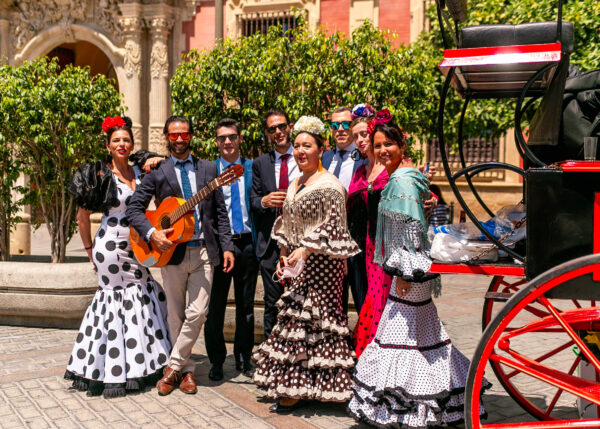
Things To Know Before Visiting Seville
Avoid visiting Seville in summer
Seville has a well-earned reputation as one of the hottest cities in Europe, and in summer that reputation becomes very personal, very quickly.
August is the worst month. Full stop. The city is known locally as an “infierno” (hell) in summer and it earns the nickname. Temperatures regularly exceed 40°C, the streets radiate heat well into the night, and many locals leave the city entirely, which means some businesses and restaurants operate on reduced hours or close altogether. July is not much better.
If you’re visiting between late June and early September, you will spend a significant portion of each day simply trying to find shade and cold water, and sightseeing in the middle of the day becomes rather unpleasant instead of just warm.
Top Tip: If you do visit in summer, structure your days around the heat. Go out early, retreat somewhere cool during the worst of the midday hours (roughly 13:00–17:00), and head back out in the late afternoon and evening. It’s how locals survive the city in August, and it works well enough to make it manageable.
My personal cut-off is May. After that, the heat starts to tip from enjoyable into exhausting, at least for someone who really just doesn’t have the energy to shower three times a day.
The months I’d actually recommend are February, March, October, and November. The temperatures are far more comfortable for walking and sightseeing, the tourist crowds are noticeably thinner, and the city feels more like itself.
Spring (particularly March and April) is beautiful, though be aware that Semana Santa (Holy Week) and the Feria de Abril draw enormous crowds and push accommodation prices up significantly, which is definitely worth knowing when you’re planning.
Skip the horse and carriage ride
This is one I feel strongly about, so I’m going to just say it plainly: please don’t take a horse and carriage ride in Seville.
The carriages are a prominent feature of the city, particularly around the Cathedral and the Alcázar, and they look picturesque enough that they attract a lot of tourist interest.
But the welfare concerns around these horses are well-documented and serious. Horses are regularly worked for long hours in extreme heat, on hard cobbled streets, in heavy traffic, with stables reportedly located over 10 kilometres from the city centre.
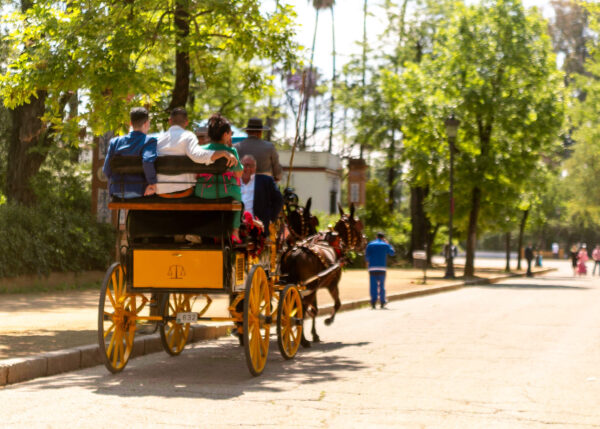
Reports of dehydration, exhaustion, and distress are consistent and ongoing, including incidents during summer months where horses have collapsed and died while working.
Barcelona has already banned horse-drawn carriages. Palma de Mallorca followed. Seville has not, despite pressure from animal welfare organisations, and despite many local residents expressing frustration that nothing has changed.
The city is very walkable, and there are much better ways to get around: on foot, by bicycle, or by e-scooter. Trams and buses cover the routes that are too far to walk comfortably. None of these options come at an animal’s expense.
If you’d like to read more about the welfare concerns before you visit, these are worth looking at:
- Journey of a Nomadic Family: Why horse carriage rides should be banned in Seville
- Lady Freethinker: Ban Horse-Drawn Carriages in Seville
- TripAdvisor forum: Disturbing Treatment of Carriage Horses in Seville
Book the Alcázar, Cathedral & Giralda in advance
The Real Alcázar is the one to prioritise above everything else. It sells out, often weeks ahead during peak season, and there is no guaranteed same-day availability.
Book as far in advance as you possibly can, and a minimum of two to four weeks ahead during busy periods is a sensible baseline, but earlier is better. Book your Alcázar tickets here!
Top Tip: Book the Alcázar the moment your travel dates are confirmed. Not the week before. Not when you arrive. The moment you know when you’re going, because realising you’ve travelled however far to then miss out on one of the top attractions in a city? Not fun.
The Cathedral and Giralda (sold as a combined ticket) are also worth booking in advance, though you have slightly more flexibility here than with the Alcázar.
For most other attractions on this list, booking a few days ahead or even on the day is usually fine outside of peak season. During the busier spring and summer months, it’s worth checking availability a little earlier, but none of the other palaces or museums carry quite the same level of demand as the Alcázar.
Eating times run late
As I covered in the eating section above, Seville runs on a significantly later schedule than most visitors expect. Locals won’t typically head out for dinner until 9pm or later,so tapas bars that look empty at 7:30pm are not bad, they just haven’t started yet! Arriving at a restaurant at 6pm will mostly earn you confused looks and a very quiet dining room, if it’s even open at all.
For a first visit, aiming for 8:00–8:30pm for dinner is a reasonable middle ground: a bit earlier than locals, but late enough to feel like you’re eating at a Spanish hour rather than an early bird special.
Where to stay in Seville
Seville’s various neighbourhoods all have a different feel, and where you choose to stay will mainly depend on your budget and your priorities for the trip.
The historic centre puts you closest to the main attractions and the best tapas bars, but it does come with the noise and bustle you’d expect from a major European city.
If you want something slightly more local in atmosphere, areas like Alameda de Hércules or just outside the immediate tourist centre give you a more neighbourhood feel without sacrificing easy access to the sights.
Here are a few of my favourite places to stay in Seville!
For amazing views of Las Setas:
Hotel Casa de Indias by Intur
This is a great mid-range option in a fantastic location, right on the Plaza de la Encarnación, which means you are essentially on the doorstep of the Metropol Parasol. The view of Las Setas from the hotel is seriously cool, plus there’s also a rooftop bar and pool area.
It’s a four-star hotel with modern, comfortable rooms, and the central location makes it ideal for exploring the whole historic centre on foot. Worth requesting a room facing the plaza if you can, as the Setas at night is quite a sight!
In a former 18th-century vestry:
Hotel Sacristía de Santa Ana
If you’re after something with real character at a more budget-friendly price, this is a lovely option. The hotel is housed in a beautiful 18th-century vestry (that’s what “sacristía” means, it’s the room in a church where vestments and sacred objects are kept), and the architecture and decor reflect that history in a way that feels charming rather than themed.
It’s located near the Alameda de Hércules, which puts you slightly further from the Cathedral than some of the other options here, but still very much within easy walking distance. The rooms are individually decorated, the beds are comfortable, and the atmosphere is calm and characterful.
Centrally located & great value:
Petit Palace Puerta de Triana
A solid, centrally located three-star hotel that offers really good value. It’s a ten-minute walk from the Cathedral, sits close to the Guadalquivir River, and has free bikes available for guests, which is a rather useful perk in a city this walkable and cycle-friendly.
Family rooms are available, breakfast is tasty, and it’s pet-friendly too. It’s the kind of hotel that doesn’t overcomplicate things: good location, clean comfortable rooms, helpful staff, fair price. Petit Palace is a small Spanish chain of hotels that are all located in unique and historic buildings, so they’re always a good brand to choose!
➡️ Double rooms from €80 per night.
Centrally located & a rooftop pool:
Hotel Rey Alfonso X
This is my pick for the best balance of location, quality, and value in Seville. It’s a four-star hotel in a converted 19th-century building in the Santa Cruz neighbourhood, a five-minute walk from the Alcázar and the Cathedral. It has a rooftop pool with views of the Giralda that is, frankly, a very good reason to come back to the hotel mid-afternoon.
The rooms are well-decorated and comfortable, the breakfast is good, and the staff consistently get excellent reviews. It’s the kind of hotel that makes you feel like you’ve chosen well.
Luxury stay & epic rooftop views:
Querencia de Sevilla
I haven’t stayed here myself yet, but it’s firmly on my list for my next Seville trip. The Querencia is a four-star Marriott Autograph Collection hotel housed in a converted former bank building in the historic centre, and it looks beautiful.
The rooftop bar and pool offer some of the best views of the Cathedral and the Giralda in the city, and the design is a lovely blend of Art Deco architecture and Andalusian detail. For a special trip or a step up in comfort, this one looks very much worth it.
For an iconic 5-star hotel:
Hotel Alfonso XIII
If you want to splurge on something truly iconic, this is it. Hotel Alfonso XIII is one of the most famous hotels in Spain: a five-star Luxury Collection property built in 1928 for King Alfonso XIII, who commissioned it to provide accommodation for visiting dignitaries during the 1929 Ibero-American Exposition.
It sits right next to the Alcázar and the Cathedral, and the building itself is a landmark. I haven’t stayed here (the price tag is, shall we say, aspirational), though we did once consider it as a potential wedding venue, which would have been rather spectacular! The interior courtyard alone is worth a visit if you’re passing.
Ideal for an Andalucía road trip:
Hotel NH Collection Sevilla
This one is a slightly different recommendation for a specific type of traveller: if you’re doing an Andalucía road trip and arriving in Seville by car, the NH Collection is very conveniently located close to the main road towards the motorway, and it sits right next to a large public parking garage, which is really quite useful in a city where parking in the historic centre is a challenge.
It’s a solid four-star option with good amenities, and the practical logistics make it a strong choice if driving is part of your trip.
So, Ready to Plan Your Seville Trip?
Seville is one of those cities that earns its reputation. The monuments are spectacular, the food is excellent, the streets are endlessly wanderable, and the city has a way of getting under your skin in a way that’s hard to explain until you’ve experienced it yourself. I’ve been four times already myself, and writing this has made me want to book my fifth and sixth stay, pronto.
Now that you have a solid list of the best things to do, where to eat, where to stay, and what to keep in mind before you go, the only thing left is to actually start planning.
A few things to do right now: book your Alcázar tickets (seriously, do this today), check availability for the Cathedral and Giralda, and start thinking about when you want to go.
If you have any flexibility on timing, I can’t recommend October or November highly enough for first-time visitors. Comfortable temperatures, smaller crowds, and a city that feels more like itself than the depths of hell it resembles at the height of summer.
To help you find everything on this list without getting lost trying to remember which street the Plaza del Cabildo was on, I’ve created a free Google Map with all the locations from this post marked and ready to use. Drop your email below to get it sent straight to your inbox.
More Seville content is on the way, including a full one-day Seville itinerary and my guide to where to stay in Seville in more detail. Save this post for when you’re planning, and feel free to come back to it!
Seville, you’re worth every bit of the hype.


