

How to Have the IDEAL Miyajima Day Trip from Hiroshima

A day trip to Miyajima (宮島) is an essential experience for anyone visiting Hiroshima. Known for its scenic beauty, cultural heritage, and – of course – its deer, Miyajima is a destination that offers so much to visitors.
The Grand Torii Gate of Miyajima is considered one of the three most beautiful views in Japan, known as ‘nihon sankei‘. Whether you see it at high tide, low tide, during the day, at sunset or lit up at night, it’s a truly magical view. There are certain ‘iconic’ views that are absolutely worth the effort in Japan and this is most definitely one of them!
If you have the opportunity, stay overnight to experience the quieter side of Miyajima without so many tourists! However, if you don’t have enough time to stay on Miyajima, a day trip will give you sufficient time to enjoy the main attractions of the island.
Here’s how you can make the most of your Miyajima day trip, from the iconic Itsukushima Shrine to the delicious momiji manjū. This Miyajima guide will provide you with the perfect itinerary for one day in Miyajima, covering all the must visit attractions as well as some lesser known spots.

Things to know about Miyajima
The official name of the island is actually not Miyajima! Its proper name is Itsukushima (with ‘shima’ being the word for island). The island itself is located in the western part of the Seto Inland Sea of Japan, in the Hiroshima Bay. Miyajima is how it’s usually referred to though, meaning ‘shrine island’.
Klook.comLinguistic note: you’ll see ‘shima’ and ‘jima’ in many Japanese place names – they both mean island, and the ‘j’ in ‘jima’ is just a hardening of the ‘sh’ in ‘shima’, as they are related letters in Japanese.
Miyajima also goes by the nickname ‘deer island’, thanks to its furry inhabitants. Just like Nara with its park full of deer, Miyajima has hundreds of wild roaming deer. Avoid taking or using plastic bags as they will try and steal your food! They are very friendly with people but will generally want to try and steal any snacks you have, so be aware of your bags – there aren’t any pickpockets to worry about here, but the deer will try to get in your bags!
Avoid feeding them, as it can harm their health and disrupt their natural foraging habits. Keep a respectful distance, and enjoy their company without disturbing them. We unfortunately saw a few tourists trying to pet the deer – please don’t be that tourist!
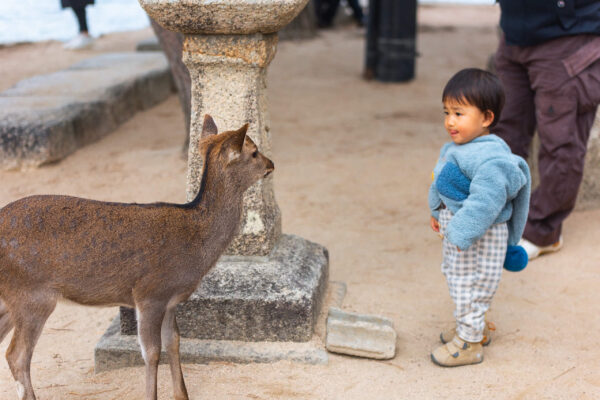
Linguistic note: these deer are known in English as ‘Sika deer’, but did you know that this name comes from the Japanese word for deer “shika”? In Japanese these deer are known as “Nihonjika” (literally ‘Japan deer’, with the hardening of the ‘sh’ to ‘j’ again!).
This means that the English name technically just means ‘deer deer’ and is an example of mixed language tautology (also known as bilingual tautological expressions), where both words have the same meaning, just in different languages.
Other examples of this phenomenon around the world include Sahara Desert (where ‘Sahara’ is Arabic for desert) and Lake Rotoroa (‘roto’ means ‘lake’ and ‘roa’ means ‘long’ in Māori, so in English we refer to it as Lake Lake Long).
The population of Miyajima is only 2,000 but receives over 3 million tourists a year (in 2019 the island hit a record visitor number of 4.66 million tourists), so I would highly recommend visiting during off-season or shoulder-season if possible.
The island and the waters around it make up part of the Setonaikai National Park, which was designated a national park in 1934. The entire national park encompasses more than 3,000 islands! Other areas of interest within the national park include Awaji Island, the Naruto whirlpools, and the island of Naoshima with its art installations.
Getting to Miyajima from Hiroshima
Miyajima is easily accessible from Hiroshima, making it a convenient day trip. To get to Miyajima from Hiroshima, take the JR Sanyo Line from Hiroshima Station to Miyajimaguchi Station in the direction Iwakuni, which takes around half an hour. From there, it’s a short walk of 5 minutes to the ferry terminal, where you can catch a ferry directly to Miyajima.
Klook.comThere are two ferry options, one being the JR West Miyajima Ferry and the other being the Miyajima Matsudai Kisen ferry. They both charge 180 yen (approximately £1/€1.15/$1.25) for the ferry journey, so you can choose whichever is the most convenient! You don’t need to buy a ticket in advance and there are multiple crossings every hour.
The ferry journey is very short – only 10 minutes – and offers beautiful views of Miyajima as you approach.
If you have a JR Pass (we used the Sanyo Sanin Pass), both the train and the ferry (JR West Miyajima Ferry only!) are included.

Miyajima Day Trip Itinerary
Morning: Visit Itsukushima Shrine (厳島神社) and Senjōkaku Pavilion (千畳閣)
Start your day with a visit to the UNESCO World Heritage Site, Itsukushima Shrine. Famous for its “floating” vermillion torii gate that appears to rise from the waters during high tide, this shrine offers a breathtaking sight that is quintessentially Miyajima. The shrine complex, built over water, is an absolutely must visit when you’re in Miyajima. Check the tide timetable to see when high and low tide is during your visit and plan your visit to Itsukushima Shrine around it – it’s a totally different experience to see the shrine at high tide compared to at low tide!
The shrine consists of multiple different buildings and is unique for the fact it was built over water on tall pillars, making it look like the entire shrine complex is floating when it’s high tide!
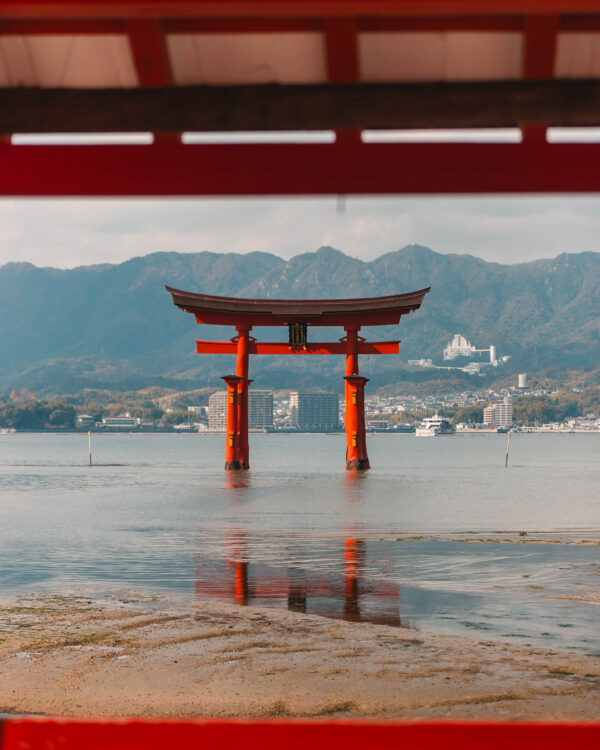

There has been a shrine on the site of Itsukushima Shrine since the 6th century, which was reportedly constructed during the reign of Empress Suiko. In 1168, Taira no Kiyomori selected the island of Miyajima as the site of his clan’s family shrine, and he built the present day Itsukushima Shrine.
The entry fee for Itsukushima Shrine is ¥300 (approximately £1.55/€1.85/$2.05), or ¥500 (£2.60/€3.10/$3.40) if you also want to visit the Treasure Hall. You’ll see a lot of people waiting in a queue to get the iconic photo in front of the torii gate – personally, I don’t think it’s worth waiting in the queue for! There are so many other vantage points for photos around the shrine, so I’d suggest just finding a quieter spot for a different angle instead.
- Where: 1-1 Miyajimacho, Hatsukaichi, Hiroshima 739-0588
- When: Opening times vary slightly during the year, so check on the official website to see the opening times for the time of year that you’ll be visiting.
- How much: ¥300, or ¥500 including the Treasure Hall
We opted not to visit the Treasure Hall as we could see the queue for it was pretty long already when we bought our tickets, but if you have time and you enjoy museums, this is definitely one to visit. It houses around 4,000 historic artefacts and is right behind the western exit.
The Grand Torii Gate, one of the most iconic views of Japan, was built in 1875. It was recently restored between the years of 2019-2022. If you visit at low tide, you can walk right up to the gate itself! Just make sure you know when low tide is and you don’t get caught out by the tide coming back in.

If you want to see the shrine from another vantage point, you can also take a boat tour to see the shrine and the torii gate from the water! These tours last 30 minutes and will take you around the bay and up to the torii gate itself. The boat tours cost 1,600 yen (approximately £8.30/€9.85/$11) and you can buy tickets when you arrive on Miyajima.
For an even more unique experience on Miyajima, you can kayak right up to the torii gate or even go Stand Up Paddleboarding (SUP) in the bay and to the torii gate!
Klook.comAfter exploring the beauty of Itsukushima Shrine (or before, if you are waiting for higher tide), head to Senjōkaku Pavilion (also known as Hokoku Shrine), the largest wooden structure on the island. Although it remains unfinished, Senjōkaku offers insight into Japan’s historical architecture and provides panoramic views of the surrounding area. During autumn, the view of the ginkgo trees surrounding the pavilion is truly picturesque.
You will also see the impressive Five Storied Pagoda (Gojunoto) when you are at Senjōkaku Pavilion. You can’t enter the pagoda but it’s impressive to see from the outside! This pagoda dates back to 1407, predating the pavilion, and enshrined Yakushi Nyorai Zazo, the Buddha of Medicine.

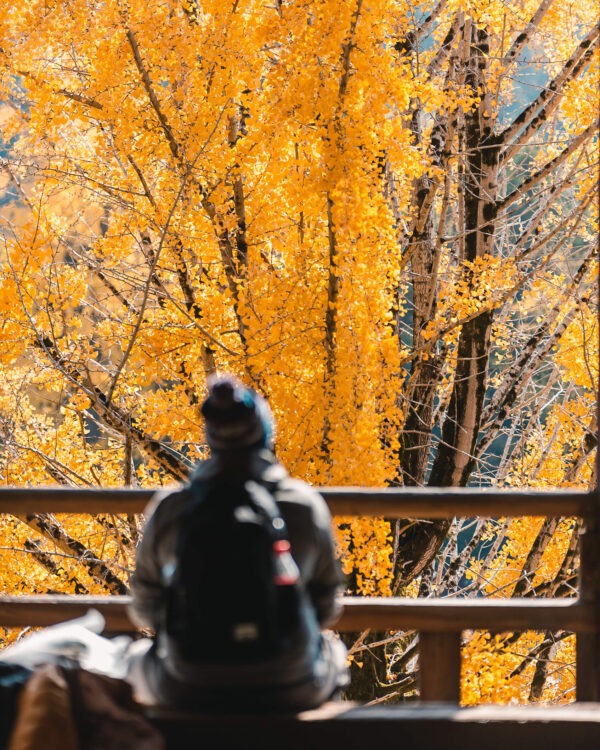
In Japanese, “Senjō” translates to ‘one thousand tatami mats’ (“sen” meaning thousand). Tatami mats was a common way to measure the size of a room or space in Japan. The pavilion was commissioned by Toyotomi Hideyoshi in 1587 to be a Buddhist library where the Senbu-kyo sutras could be chanted for fallen soldiers, but after his death in 1598 it was never completed.
When you visit Senjōkaku, make sure to take your shoes off before entering. You can get a bag at the entry to carry them in, which is where you pay your entry fee. The entry fee to Senjōkaku is 100 yen (£0.50/€0.60/$0.70).
- Where: 1-1 Miyajimacho, Hatsukaichi, Hiroshima 739-0588
- When: Every day from 08:30-16:30.
- How much: ¥100
Lunchtime: Miyajima BASE
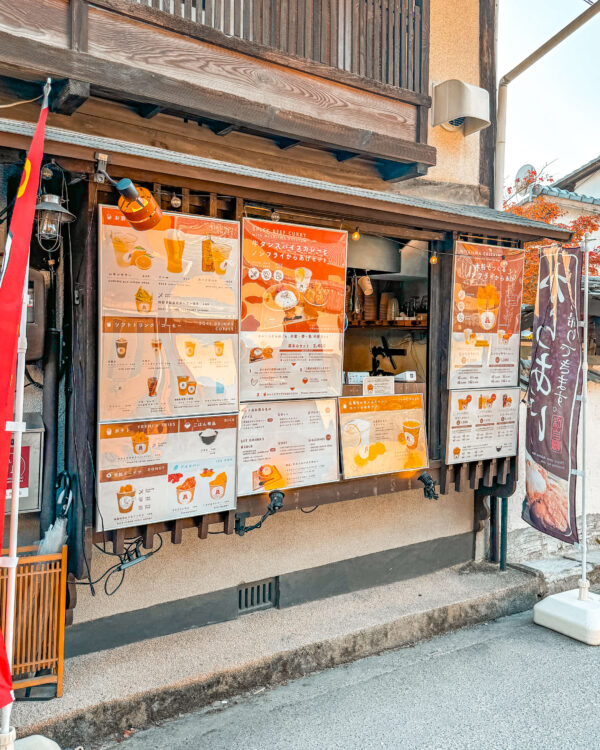
After exploring Senjōkaku Pavilion and Itsukushima Shrine, treat yourself to a tasty lunch at Miyajima BASE. The karaage (fried chicken) and beef curry are must-try dishes! Interestingly, everything at Miyajima BASE is gluten free, milk free, and egg free, which is great if you are coeliac, gluten intolerant, or lactose intolerant.
You can choose from a variety of meal sets, with the base set including their spicy beef curry, rice, three pieces of karaage, and a drink. The set costs 2,400 yen (approximately £12.50/€14.80/$16.40), with the included drink being coffee, hot lemonade, Coca Cola, or lassi. You can also choose sparkling lemonade, beer, shochu lemon soda or whisky soda for an extra 100 yen.
They also offer meal sets for just the karaage, with 3 pieces of chicken and a drink starting at 1,150 yen (£6/€7.10/$7.90).
For just chicken on its own, you can get 3 pieces for 700 yen, 5 for 1,100 yen, 8 for 1,700 yen and 12 pieces for 2,500 yen. The chicken AND the curry were so good and I can’t recommend this place enough!
Between two of us, we bought the curry and chicken meal set with 5 pieces of chicken for 2,800 yen (approx. £14.60/€17.25/$19.20), plus an extra drink, which was a perfect amount for sharing between us. Less than £15 for delicious lunch for two in a very popular tourist location isn’t bad at all!
In summer, they also offer frozen fruit ice pops as well, but since we visited in chilly November, we didn’t have the opportunity to try these. The photos customers have shared on Google Maps look delicious!
- Where: 310 Miyajimacho, Hatsukaichi, Hiroshima 739-0588
- When: Thursday to Tuesday 10:00-18:30, Wednesday 10:00-16:00
- How much: Approximately ¥1,000-¥2,500 per person

Afternoon: Experience Miyajima Ropeway (宮島ロープウェイ) and Explore Momijidani Park (紅葉谷公園)
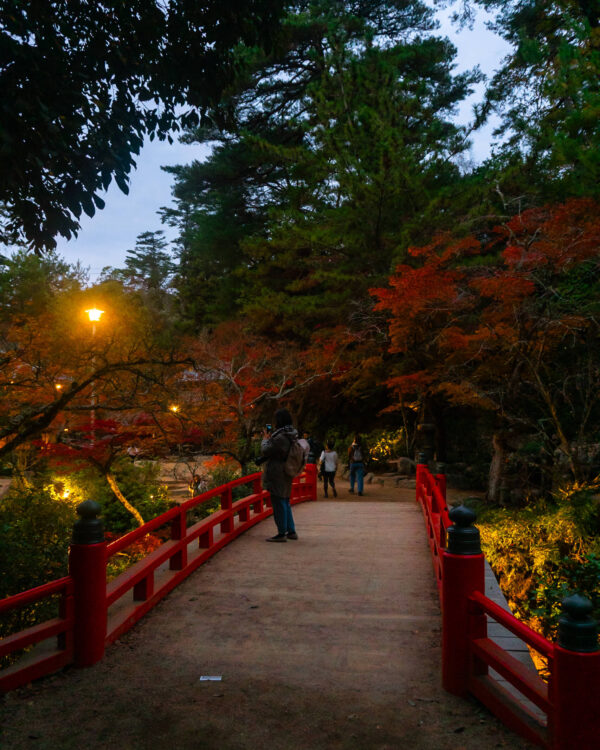
After filling up on delicious chicken and curry, make your way to Momijidani Park. Known for its vibrant autumn colours and serene atmosphere, it’s an ideal spot for a relaxing stroll amidst nature! While most beautiful in autumn, with the bright red of maple leaves (momiji) that fill the park with their vibrant colours. The park is located at the foot of Mount Misen, the highest point on Miyajima.
Even if you aren’t doing an autumn day trip to Miyajima, Momijidani Park is still spectacular all year round. In spring, cherry blossoms bloom and in summer the park is vibrant with green leaves. Even in winter, the the park is scenic and you might even get to see the foliage dusted in light snowfall!
One interesting fact is that Momijidani Park was badly damaged after a typhoon hit Miyajima in 1945. The entire park underwent extensive erosion control work and restoration. A major restoration effort started in 1948, which involved careful reconstruction to preserve the park’s natural beauty.


After exploring the park for a while, make your way to the Miyajima Ropeway (宮島ロープウェイ) for a scenic ascent to the Shishiiwa Observatory. You’ll need to take two cable cars to reach the peak, with a transfer at Kayadani Station halfway up. You can choose whether to get the ropeway the entire way up and back down, or to only get the ropeway one direction and hike the other direction.


The ropeway journey offers spectacular views of the Seto Inland Sea and the lush forests covering the island. Once at the top, the Shishiiwa Observatory provides a stunning vantage point to appreciate all of Miyajima’s natural beauty, as well as the other islands within the Inland Sea. If you want to, you can also walk up to Mount Misen Observatory, which is quite a steep trail but passes beautiful locations along the way such as the Eternal Flame of Reikado Hall. We opted not to walk up here since I have back problems, but if you’re able-bodied and relatively fit it shouldn’t be an issue at all! Mount Misen Observatory will allow you to enjoy a 360 degree panoramic view of the Seto Inland Sea, while you can only see part of it from Shishiiwa Observatory.
We went up around an hour before sunset, making the light absolutely beautiful over the sea and the forests. The view is truly spectacular!


Evening: Sample momiji manjū and see the sunset
Whether you take the ropeway back down or hike the entire way back down the mountain, make sure not to leave the island without sampling the famous momiji manjū at Momijido Main Store. These maple leaf-shaped cakes are traditionally filled with sweet red bean paste, although they also offer lots of other delicious fillings such as chocolate, custard, or even cheese! These are a perfect souvenir to remind you of your Miyajima day trip. You can also try Agemomiji, which is a deep-fried version of momiji manjū and is delicious – I tried the custard one and it was so good.
Wander along Omotesandō Shopping Street to browse the various stores selling souvenirs and handicrafts! It’s a great opportunity to buy a souvenir or gifts for friends and family. If you are planning on coming back down the ropeway later in the evening (i.e. after 5pm), I’d recommend visiting the shopping street before visiting Momijidani Park as the majority of shops close at 6pm.


Whether you choose to see the sunset from the ropeway on your way back down to town (like we did), or watch the sun set through the torii gate, I highly recommend staying to see sunset on Miyajima before heading back to Hiroshima by ferry.
There are so many great spots on the island to enjoy sunset from!
After enjoying a picturesque sunset, head back to Miyajima Pier to return by ferry to Miyajimaguchi and take the JR Sanyo Line back to Hiroshima.

Is a Miyajima Day Trip worth it?
I would say absolutely yes! While Miyajima is a popular destination and it won’t be a hidden gem in Japan that you get all to yourself, it is popular and loved for a reason. The iconic torii gate is truly impressive, and visiting in different seasons will show you a different side of Miyajima!
I personally feel that autumn is one of the best times to visit due to the spectacular maple leaves that turn bright red throughout Momijidani Park, but a Miyajima day trip is worth it any time of year.
You can easily see all the main attractions on Miyajima within one day, but if you have the time in your itinerary to stay overnight – or want to have a more relaxed visit and see Miyajima without all the day trippers – then book a stay in one of the ryokans on the island for a totally different experience of this island.
Can I visit Hiroshima and Miyajima in one day?
I would say no. While in theory you can visit the main sights in Hiroshima, take the ferry, see the main sights on Miyajima and then get the ferry back to Hiroshima, I wouldn’t recommend it. You would have to rush to visit the main sights in both places and it would be an awfully long day – in my personal opinion, it just wouldn’t be worth it!
There are day trip options from Kyoto, Osaka and Hiroshima that also include a visit to the Atomic Bomb Dome, Peace Memorial Park and the Hiroshima Peace Memorial Museum, but the only attraction included on Miyajima is Itsukushima Shrine. If you are short on time and really want to visit them both in one day, it is possible but you won’t have the time to also visit Momijidani Park, Senjōkaku Pavilion, or take the ropeway up Mount Misen.
Klook.comAt minimum, I would suggest booking at least two nights in Hiroshima (we did three nights, which was perfect for us as it meant we could dedicate one entire day to Hiroshima and one entire day to Miyajima). Spending two nights in Hiroshima means that you can see the main attractions in Hiroshima in the afternoon when you arrive and the morning of when you depart, and still have a full day to explore Miyajima.
We travelled to Hiroshima from Kyoto via Osaka (the direct Shinkansen from Kyoto to Osaka wasn’t included with our rail pass) and arrived in the evening, meaning that we then had the next full day to explore Hiroshima, one day after that to do our Miyajima day trip, and then on our checkout day we saw a few last things in the morning before taking the train up to Maibara via a few hours in Himeji.
Note: We used Maibara as a place to stop on the way from Hiroshima to Toyama. In retrospect, stopping overnight in Osaka would have been much better! While there are some nice places near Maibara (such as Hikone), Maibara itself is highly uninspiring and had not much to do at all.
Can I do a guided day trip to Miyajima?
Of course! There are lots of options on Klook and GetYourGuide for a guided tour to Miyajima.
There are a variety of tours, such as a historic half-day walking tour that includes Itsukushima Shrine, Daisho-in Temple, Miyajimacho, Five Story Pagoda, and a lunch at a local Japanese restaurant. There are also private tour options.
Klook.com
Conclusion: Making the Most of Your Miyajima Day Trip
A day trip to Miyajima offers a unique blend of cultural, historical, and natural attractions. From the grandeur of Itsukushima Shrine and the Five Story Pagoda, to the natural beauty of Momijidani Park and Mount Misen, Miyajima provides a memorable experience in Japan.
If you’re visiting Hiroshima, a trip to Miyajima is a must. Miyajima is so easily accessible from Hiroshima and makes for the perfect day trip.
Whether you’re visiting Miyajima for the iconic torii gate, to see the spectacular autumn foliage in Momijidani Park, or you simply want to escape the bustle of the big city, you are sure to enjoy your Miyajima day trip.
Don’t forget to pin this article if you found it useful!


